
7 Souvenirs from Thessaloniki Worth Buying: Icons, Byzantine Jewellery, Food and Where to Find Them.
Table of Contents
Introduction
The best souvenirs from Thessaloniki fall into two broad categories: objects rooted in the city’s Byzantine and Orthodox heritage — icons, jewellery, ceramics — and food products from the covered markets that have supplied the city since the Ottoman period.
Neither category requires significant budget; most of the items below are available for under €30, several for under €15, and the markets sell food products that are both genuinely local and easy to carry through an airport.
What follows is a practical guide to seven categories of souvenirs from Thessaloniki, with specific locations, approximate prices and notes on quality.
The list prioritises items that are made or sourced in the Thessaloniki region rather than mass-produced imports, which requires some navigation — the city’s tourist-facing shops mix both freely, and the difference is not always marked.
1. Hand-painted and printed icons (€8–€180)

Icons are the most widely available Byzantine gift in Thessaloniki and also the most variable in quality.
The distinction that matters is between screen-printed icons on wood, which retail from approximately €8 to €25 and are produced industrially, and hand-painted icons on gessoed wood using egg tempera, which begin around €60 for small pieces and can reach several hundred euros for larger works from established workshops.
Both are legitimate religious objects; the difference is in longevity and artistic value. The most reliable source for hand-painted icons in Thessaloniki is the workshop district around Agia Sophia church, where several family-run icon painters have operated for decades.
The Museum of Byzantine Culture gift shop (Stratou 2) stocks a curated selection of printed icons based on objects in the permanent collection, with attribution to the original works — a useful feature if the icon’s historical context matters.
Religious supply shops near the Church of Saint Demetrios on Agios Dimitrios Street stock both categories at competitive prices and are oriented toward local buyers rather than tourists, which generally means lower margins.
2. Food products from the covered markets (€4–€20)
Thessaloniki’s food reputation rests partly on its Ottoman-era market infrastructure. Kapani Market (Agora Kapani), operating continuously since the Byzantine period on Komninon Street, and Modiano Market, a 1922 covered hall restored between 2019 and 2022, both sell products that are difficult to find outside the region.
The most practical to carry are Macedonian halva — the Thessaloniki version is denser and less sweet than the Athens equivalent, often flavoured with pistachios or chocolate — tahini from the city’s sesame-processing tradition, and dried herbs and spice blends from the Kapani stalls.
Tsipouro, the unsweetened grape marc spirit produced in Macedonia and Thessaly, is available in the markets in both plain and anise-flavoured versions; it travels well in checked luggage but not in hand luggage beyond 100ml.
Local honey — particularly thyme honey from Mount Chortiatis east of the city — is sold by weight at several Kapani stalls and by specialist producers at the Saturday organic market on Olympou Street. Bougatsa mix, the semolina custard filling associated specifically with Thessaloniki’s version of the pastry, is sold packaged at several delicatessens around Tsimiski Street.
3. Byzantine-inspired jewellery (€15–€200)
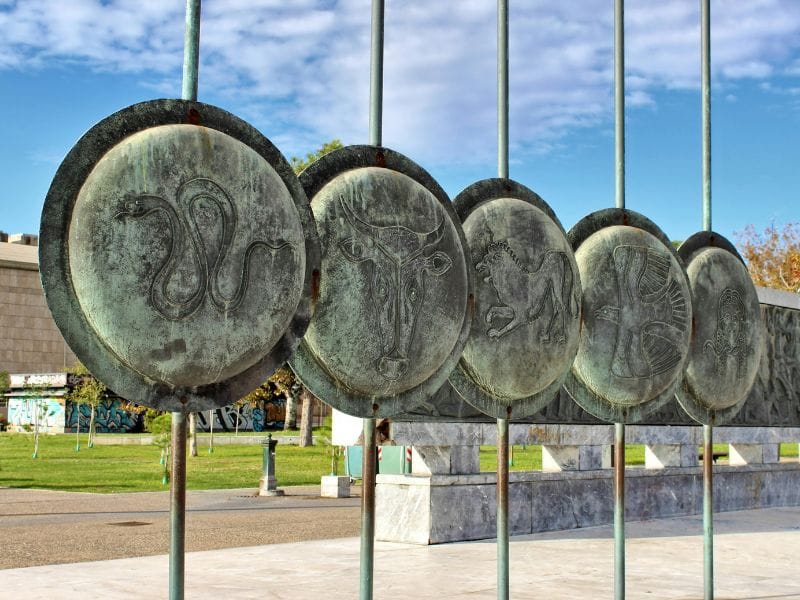
Thessaloniki has a working jewellery tradition that draws directly on Byzantine motifs: the double-headed eagle, the Macedonian star, cross designs derived from church ornamentation, and enamel techniques adapted from Byzantine cloisonné.
Several workshops in Ladadika — the former wholesale district two blocks west of the port, now a mix of bars, restaurants and craft shops — produce pieces in bronze, silver and gold-plated silver that are designed and made on the premises rather than imported.
The Museum of Byzantine Culture gift shop stocks a range of reproduction jewellery based on objects in the permanent collection, each piece labelled with the original artefact it references — a useful provenance for Byzantine gifts from Thessaloniki intended for recipients with an interest in the history.
Prices in the museum shop run from approximately €15 for small bronze pendants to €80 for silver pieces with enamel detail. Independent jewellery workshops on Egnatia Street and in Ano Poli generally offer comparable quality at slightly lower prices, with the advantage of being able to watch the work in progress.
4. Ceramics and hand-painted tiles (€10–€60)
Thessaloniki’s ceramic tradition draws on the Ottoman and Byzantine layers of the city’s history: geometric patterns derived from church floor mosaics, cobalt and terracotta colour palettes from the region’s Islamic-era tilework, and cross and star motifs adapted from Byzantine architectural decoration.
The most practical pieces of souvenirs from Thessaloniki for travellers are flat items — decorative plates (20–25cm diameter), coaster-sized tiles and small wall-mounted squares — which pack flat and survive transit well when wrapped in clothing.
Craft fairs on Aristotelous Square, held on most weekends between April and October, include ceramic vendors from across the region; prices are generally lower than in fixed shops and pieces are often signed by the maker.
The Museum of Byzantine Culture and MOMus — the Museum of Modern Art Thessaloniki on Stratou Avenue, 400 metres east — both stock ceramics in their gift shops that are specifically designed as reproductions of or responses to works in their collections.
The MOMus shop in particular has a stronger contemporary design orientation if the purely historical reference is less important than the aesthetic.
5. Books on Byzantine art and Thessaloniki (€12–€45)
IANOS bookstore on Tsimiski Street — Thessaloniki’s largest independent bookshop, occupying a listed neoclassical building at number 12 — stocks an extensive English-language section on Byzantine art, Orthodox theology, Greek history and regional archaeology.
The Museum of Byzantine Culture’s permanent collection catalogue, available in English at the museum shop for approximately €22, is the most authoritative single-volume introduction to the city’s Byzantine heritage and includes a chapter on female patronage and religious life not easily found elsewhere.
The museum also stocks the iMEdD journalism lab’s 2023 digital archive project catalogue on Byzantine Thessaloniki, which maps surviving donor inscriptions across the city.
For children, the museum shop stocks an illustrated guide to Byzantine art at €6 and a colouring book based on mosaic patterns at €4 — both produced specifically for the museum’s education programme rather than sourced from generic souvenir suppliers.
6. Orthodox incense and beeswax candles (€5–€25)
Orthodox frankincense — livani in Greek — is produced from Boswellia resin and used in every Orthodox church service in Greece.
The finest quality comes from the Greek island of Chios, where Boswellia sacra has been cultivated since antiquity under the name mastiha; Thessaloniki’s religious supply shops stock both Chian and imported varieties, labelled and priced accordingly.
Small boxed sets combining frankincense crystals, a charcoal disc and a small brass censer are sold in religious supply shops around the major churches for approximately €8–15 and are a practical purchase for anyone who wants the sensory reference without buying a full liturgical set.
Hand-rolled beeswax candles, as distinct from the paraffin candles sold inside churches for €0.50, are available from monastery-affiliated shops and from the Vlatadon Monastery shop in Ano Poli, which is open to visitors during designated hours.
The Vlatadon shop also sells locally produced honey and herbal products from the monastery’s own gardens — a useful stop that combines two categories on this list in one location.
7. Textiles with Byzantine and Macedonian patterns (€15–€80)

Macedonian textile patterns — geometric borders, stylised floral motifs and the 16-point Vergina Sun — appear on scarves, table runners and cushion covers sold in specialist craft shops and at the weekend market on Aristotelous Square.
The distinction between machine-printed fabric with regional motifs and hand-woven or hand-embroidered pieces is significant in both price and durability; the latter begin around €35 for a scarf and are typically sold by small producers rather than souvenir chains.
Cotton and linen blends with natural dyes are common in the higher-quality end of the market and are better suited to daily use than synthetic alternatives. The Ano Poli district has several small boutiques specialising in handmade textiles; the walk up from the Forum to Vlatadon Monastery passes most of them.
For Byzantine gifts from Thessaloniki with a textile focus, the Museum of Byzantine Culture gift shop stocks scarves and printed fabric pieces based on patterns from objects in the collection — a category that is better curated there than in the general souvenir market.
Where to buy souvenirs from Thessaloniki
The Museum of Byzantine Culture gift shop on Stratou Avenue is the single most reliable source for Byzantine gifts in Thessaloniki across multiple categories — icons, jewellery, ceramics, books and textiles — with the advantage that every piece is selected for its connection to the museum’s collection.
It is not the cheapest option, but it is the most consistent for quality and provenance. The shop is open during museum hours (Tuesday to Sunday, 08:00 to 20:00 in summer) and does not require a museum ticket to enter.
Kapani and Modiano markets are the best sources for food products and cover a combined footprint of several city blocks between Egnatia Street and the port.
The Aristotelous Square weekend craft fair, running most Saturdays and Sundays between April and October, is the most efficient single location for ceramics, textiles and jewellery from regional producers.
Ano Poli rewards visitors who have time to walk: the concentration of independent workshops along Eptapyrgiou Street and the path to Vlatadon covers most of the non-food categories on this list within a 20-minute stroll.
Makedonia Airport stocks a limited selection of packaged food, books and printed souvenirs in the departures hall; prices are 15–25% higher than city-centre equivalents and the selection does not include hand-painted icons, craft jewellery or hand-woven textiles.
Buying at the airport is a practical fallback for food products and books but not for the craft categories where provenance and quality require seeing the object in person before purchasing.