
The Macedonian Renaissance: How Byzantium Recovered Ancient Greek Learning and Reinvented Its Own Art (867–1056 AD)
Table of Contents
Introduction
The term “Macedonian Renaissance” was coined by art historian Kurt Weitzmann in 1963. It describes the cultural revival that accompanied the Macedonian dynasty’s rule from 867 to 1056 AD.
The name has a double meaning: it refers to a dynasty founded by Basil I from the Macedonian theme, and to a recovery of classical Greek learning that Weitzmann called a genuine renaissance — nearly six centuries before Italy made the same claim. The period produced some of the most accomplished objects in Byzantine art history.
The Paris Psalter (Bibliothèque nationale de France, ms. gr. 139) is a 10th-century psalter with full-page miniatures drawn directly from Hellenistic painting. The Paris Gregory (BNF ms. gr. 510) is a 9th-century illustrated manuscript of Gregory of Nazianzus’s sermons.
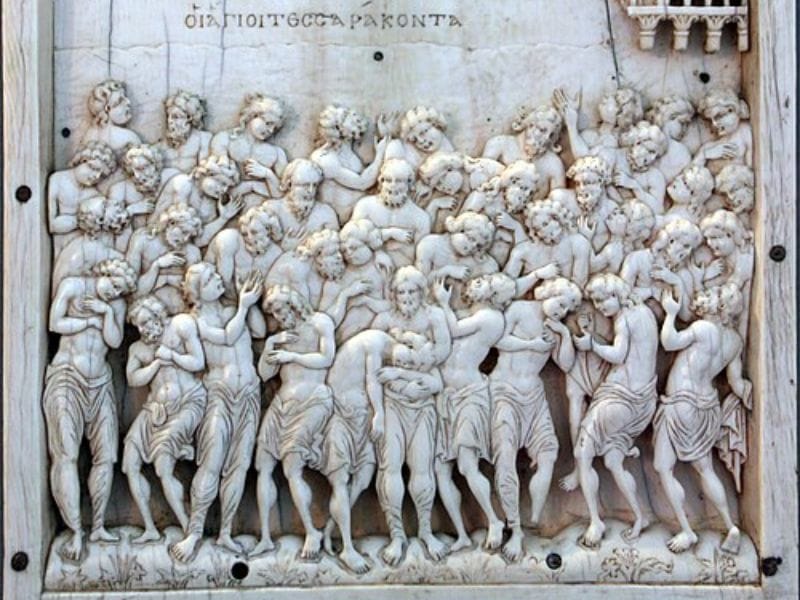
The ivory triptychs and reliquary boxes of the 10th century show a mastery of classical carving technique unmatched anywhere in Europe at the time. None of these objects are in Thessaloniki, but the Macedonian Renaissance’s consequences are visible in every major Byzantine monument the city holds.
Patriarch Photios and the recovery of ancient Greek knowledge
The intellectual side of the Macedonian Renaissance predates the dynasty itself. Its central figure is Patriarch Photios of Constantinople (c. 820–893 AD). Photios was the most widely read man in 9th-century Byzantium — possibly in the entire medieval world.
His Bibliotheca, written around 855 AD before his first patriarchate, summarises approximately 280 texts. Many of those texts have since been lost. Scholars estimate that between 30 and 50 works survive today only because Photios described their contents.
Photios also commissioned the first major post-iconoclast mosaic programme in Constantinople. The apse mosaic of Hagia Sophia was completed in 867 AD. He unveiled it in a homily calling it proof that iconoclasm was finally over. The mosaic still survives in the Hagia Sophia, now a mosque.
It is considered the foundational artwork of the Macedonian Renaissance. Photios thus connects the intellectual and artistic dimensions of the period: both were part of the same project of reconstruction after the iconoclasm crisis.
Constantine VII Porphyrogennetos: the scholar-emperor
Constantine VII Porphyrogennetos (913–959 AD) is the figure most directly responsible for the Macedonian Renaissance’s literary output. He was sidelined from political power for much of his reign by the co-emperor Romanos I Lekapenos. Constantine used that enforced leisure to write and commission at an extraordinary pace.
The De Administrando Imperio is a confidential manual written for his son on imperial governance and foreign relations. It remains one of the most important primary sources for 10th-century European and Middle Eastern political geography.
The De Ceremoniis, his account of Byzantine court ceremonial, is the primary source for understanding how the imperial palace functioned as a symbolic and liturgical space. Constantine also supervised encyclopaedic compilations that extracted knowledge from earlier classical and Byzantine sources.
The Excerpta Historica covered history. The Geoponica covered agriculture. The Hippiatrica covered veterinary medicine. These are not original works, but they preserved material from texts that subsequently disappeared.
His court scriptorium also produced the earliest surviving illustrated copy of the Iliad — the Venetus A, now in the Biblioteca Marciana in Venice. The Paris Psalter’s Hellenistic-style miniatures were almost certainly produced under his direct patronage.
Byzantine art in the 9th and 10th centuries: what the Macedonian Renaissance produced

The visual output of the Macedonian Renaissance falls into four main categories. Illuminated manuscripts — psalters, gospel books, hagiographic and scientific texts — show a direct return to classical Hellenistic conventions. They use three-dimensional modelling, landscape settings and figures in classical poses.
The Paris Psalter’s miniature of David as a musician reproduces a Hellenistic painting type as accurately as any 15th-century Italian humanist could have managed. Byzantine art of the 9th century also produced a major expansion of monumental mosaic programmes.
The post-843 restoration required systematic redecoration of churches stripped during the iconoclast period. Macedonian-period workshops developed a standardised approach to apse, nave and narthex decoration.
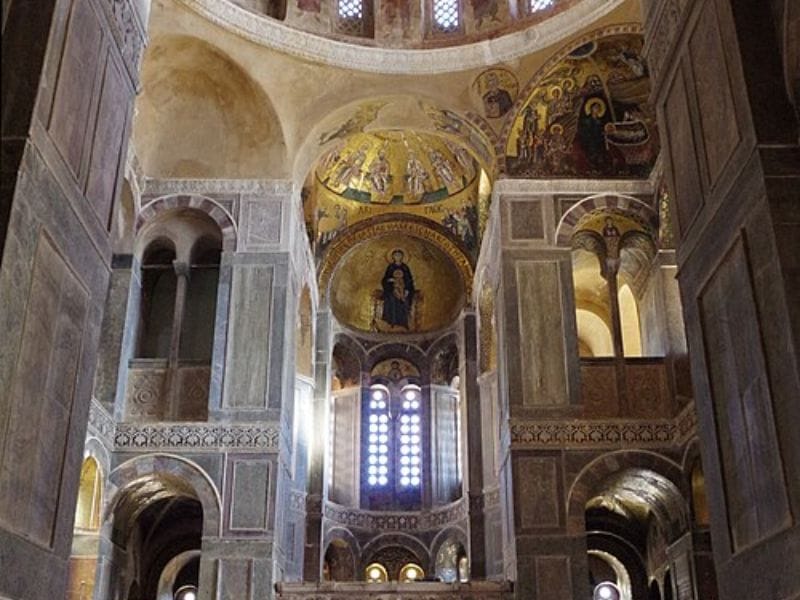
That model governed all subsequent Byzantine church design. In Thessaloniki, the post-iconoclast extension of the Rotunda’s mosaics and the restoration of frescoes in Ano Poli churches both fall within this period.
Ivory, enamel and metalwork: the luxury arts of the Macedonian court
The most technically demanding Macedonian Renaissance objects are the carved ivory triptychs, diptychs and reliquary boxes produced in Constantinople from the late 9th to mid-11th century. Approximately 100 survive in major collections worldwide. They show a mastery of classical relief carving unseen in the Byzantine world since the 6th century.
The Harbaville Triptych (Louvre, Paris) and the Romanos Ivory (BNF Cabinet des Médailles, Paris) are the most reproduced examples. Both show Christ crowning imperial figures alongside classical figural conventions. Cloisonné enamel reached its Byzantine peak during the Macedonian period.
The technique fills gold wire compartments with coloured glass paste, then fires them to produce jewel-like surfaces. The Pala d’Oro in Venice’s Basilica of San Marco incorporates Byzantine enamel panels from the 10th–12th centuries.
It gives the best accessible impression of Macedonian enamel work at scale, though its current form postdates the dynasty. The technique was an imperial workshop monopoly. It functioned as a diplomatic currency — given as gifts to rulers from the Carolingian court to the Abbasid caliphate.
The Macedonian Renaissance and the Christianisation of the Slavic world
The most durable geopolitical consequence of the Macedonian Renaissance was the Christianisation of Bulgaria and Kievan Rus. Both occurred during the dynasty’s rule. Both transmitted Byzantine art, liturgy and intellectual culture to regions that became its primary carriers after 1453.
Saints Cyril and Methodios were brothers from Thessaloniki. In 863 AD, Patriarch Photios and Emperor Michael III sent them to Moravia. They created the Glagolitic alphabet — later systematised as Cyrillic — to make Byzantine texts accessible in Slavic. The decision to conduct the liturgy in Slavic rather than Greek was controversial.
It was also decisive: Byzantine Christianity took root as a living tradition rather than an imported foreign practice. Prince Vladimir of Kievan Rus converted to Christianity in 988 AD. His ambassadors had attended a service at Hagia Sophia and reportedly said they could not tell whether they were in heaven or on earth.
The conversion transmitted the Macedonian Renaissance’s visual programme to Russia, Ukraine and Belarus. The Byzantine church scheme — apse Virgin, Pantocrator in the dome, narrative scenes in the nave — was standardised during the Macedonian period. It became the template for Orthodox church decoration across the entire Slavic world. It remains so today.
What the Macedonian Renaissance left in Thessaloniki
Thessaloniki was the second city of the Byzantine Empire. It was also the birthplace of Cyril and Methodios.
Its connection to the Macedonian Renaissance is both political and cultural. The city’s surviving Byzantine churches contain fresco and mosaic programmes executed during the Macedonian period or directly reflecting its iconographic conventions.
The Rotunda’s post-iconoclast mosaics, the fresco cycles in Ano Poli churches and the donor portraits at Vlatadon Monastery all follow the visual standards codified under the Macedonian emperors and Patriarch Photios.The Museum of Byzantine Culture’s Rooms 6 and 7 cover the Middle Byzantine period corresponding to the Macedonian Renaissance.
The collection includes icons, ceramics, personal ornaments and liturgical objects from the 9th to 12th centuries. Room 7’s glazed ceramics — bowls and plates from Constantinople and Thessaloniki workshops — show the period’s combination of classical decoration and Christian iconography at the everyday level rather than the imperial luxury level.
Why some historians reject the term “Macedonian Renaissance”
Weitzmann’s term has been contested since its introduction. The main objection is that it implies a rupture and recovery analogous to the Italian Renaissance. In reality, Byzantine engagement with ancient Greek texts had never fully ceased.
Photios was summarising texts continuously copied in Byzantine monasteries — not rediscovering lost knowledge from a dark age. A second objection is that the classical revival was largely a court phenomenon in Constantinople. It had limited direct impact on the broader production of icons and church frescoes that make up most surviving Byzantine art.
Both objections have merit. The term persists because it names a real and documentable intensification of intellectual and artistic production under the Macedonian dynasty. The objects it produced — the Paris Psalter, the ivory triptychs, the enamel work — are of sufficient quality and influence to require a specific conceptual frame.
Visitors to Thessaloniki are not encountering the dynasty’s court luxury objects directly. They are encountering the standardised visual programme the period produced — the one that governs every icon and fresco in the city’s churches.