
Byzantine Influence on Modern Greece: Six Areas Where It Is Still Concretely Visible
Table of Contents
Introduction
The Byzantine Empire ended on 29 May 1453 when Ottoman forces under Sultan Mehmed II entered Constantinople. But the institutions, visual traditions and legal frameworks of the empire did not end with it.
Six areas of Greek life today carry measurable Byzantine influence — not as historical atmosphere or cultural sentiment, but as specific, documentable continuities. Understanding them changes how you read both the museums and the streets of Thessaloniki.
1. The Greek Orthodox Church: constitutional continuity since the 4th century
The Greek Orthodox Church is the only institution in modern Greece with an unbroken institutional continuity to the Byzantine period.
The 1975 Greek Constitution, Article 3, establishes it as the prevailing religion of Greece and guarantees its auto-cephalous status. Approximately 90% of Greek citizens are baptised Orthodox, according to the 2011 census — the most recent to include religious affiliation data.
The Church is funded partly through the Greek state budget; clergy are paid as civil servants under a system whose precedent dates to the Byzantine arrangement between the imperial office and the Patriarchate.
The Greek Orthodox liturgy in use today is structurally identical to the liturgy codified in the 4th to 8th centuries. The Divine Liturgy of Saint John Chrysostom, the primary Sunday service, was established in the 4th century and has been performed continuously in Greek since then.
The music — Byzantine chant, a monophonic tradition using the eight-tone system (oktoechos) developed under Saint John of Damascus in the 8th century — has not been replaced by polyphonic harmony in any Greek Orthodox church.
When you attend a service in Thessaloniki’s Basilica of Agios Dimitrios, you are hearing a musical and liturgical tradition in uninterrupted use for approximately 1,600 years.
2. The Greek language: Byzantine Greek as the bridge to the present
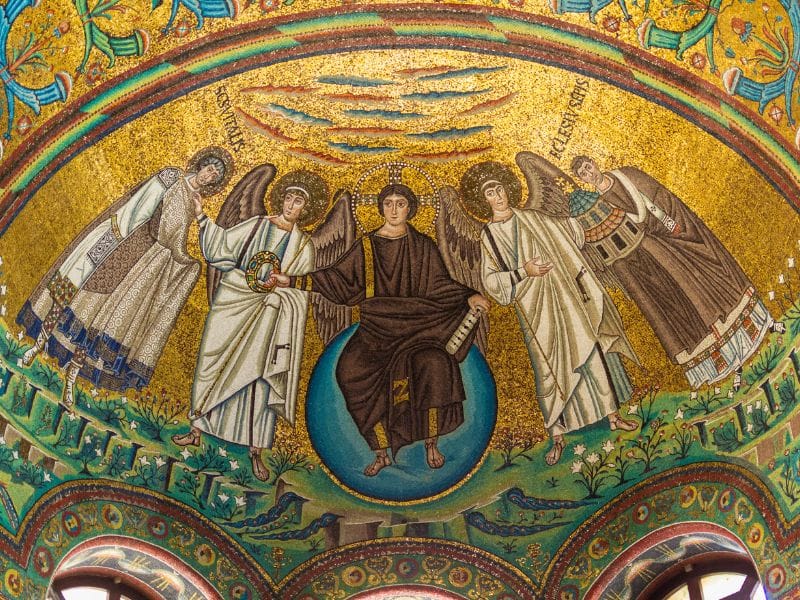
Modern Greek descends from Byzantine Greek, which in turn descends from the koine dialect that served as the lingua franca of the eastern Mediterranean from the 3rd century BCE onward. The continuity is not metaphorical.
Core vocabulary, grammatical structures and orthographic conventions in Modern Greek derive directly from Byzantine usage. Greek is the only European language with a continuous written record spanning more than 3,000 years.
The Byzantine layer is most visible in religious vocabulary still in daily use: words like “ekklisia” (church, from Byzantine ecclesiastical Greek), “papas” (priest), “ikonostasi” (iconostasis), “liturgia” (liturgy).
The 19th and early 20th-century katharevousa — the formal written Greek used in official documents until 1976 — was a deliberate attempt to purify Modern Greek by removing Ottoman-period loanwords and restoring Byzantine and ancient forms.
The demotic eventually prevailed, but katharevousa survivals persist in legal, ecclesiastical and formal registers that any reader of Greek law or church texts encounters regularly.
3. The Greek Orthodox tradition in visual art: icon workshops still active today
Byzantine icon painting is not a historical technique. It is a living craft practised in workshops across Greece, with the highest concentration on Mount Athos and in Thessaloniki.
The techniques in use — egg tempera on gessoed wood, gold leaf applied over bole, the iconographic types codified after 843 AD — are the same as those documented in the 15th-century Painter’s Manual (Hermeneia) of Dionysios of Fourna.
The manual, compiled around 1730–1734, itself codified practices continuous from the Byzantine period. Several professional icon-painting workshops operate in Thessaloniki’s Ano Poli district and around the major churches.
Their output serves both the domestic Greek Orthodox tradition and an international market for liturgical art. The Greek Orthodox tradition in icon painting was formally recognised by UNESCO as an intangible cultural heritage candidate in 2019.
The Museum of Byzantine Culture’s gift shop sells reproduction icons based on works in the permanent collection, each attributed to the original object — a practice that distinguishes them from generic devotional copies.
4. Byzantine influence in Greek civil law: the 1946 Civil Code

The Greek Civil Code, which entered into force on 23 February 1946 and replaced the Ottoman Mejelle system in effect since 1856, drew directly on Byzantine law as codified in Justinian’s Corpus Juris Civilis (529–534 AD) and in the Basilika, the 10th-century Macedonian-dynasty compilation of Roman and Byzantine legal precedent.
The drafting committee, chaired by Professor Georgios Maridakis, explicitly cited the Byzantine legal tradition as a primary source alongside the German BGB and the French Code Civil.
Specific Byzantine legal concepts that survived into the 1946 Code include the institution of the dowry (proika), the distinction between movable and immovable property as defined in Byzantine property law, and certain inheritance rules derived from Justinianic novel legislation.
The dowry was formally abolished by Law 1329/1983 as part of the family law reform that introduced gender equality into Greek family law — but its 37-year presence in the 1946 Code illustrates how directly Byzantine legal institutions persisted into the modern Greek state.
5. Thessaloniki’s urban fabric: fifteen UNESCO monuments and a still-functioning wall
Thessaloniki has fifteen UNESCO World Heritage monuments, all Byzantine, inscribed since 1988. They are not isolated archaeological sites. They are integrated into a functioning city. The Basilica of Agios Dimitrios holds regular liturgy.
The Rotunda serves as a monument and occasional concert venue. The Byzantine walls of Ano Poli define the northern boundary of the city’s most visited neighbourhood and serve as a public promenade.
The Heptapyrgion fortress operated as a prison until 1989 and is now an archaeological site open to visitors.The 1917 Great Fire destroyed most of the lower city, which was subsequently rebuilt on a French-designed grid. Ano Poli was largely spared.
The result is a direct physical continuity: streets in Ano Poli follow alignments documented in 14th and 15th-century Ottoman cadastral surveys that recorded existing Byzantine-era property boundaries. The urban morphology of the upper city has not been replaced. It has been continuously inhabited on its medieval footprint for over 600 years.
6. The liturgical calendar: Byzantine feasts as national public holidays
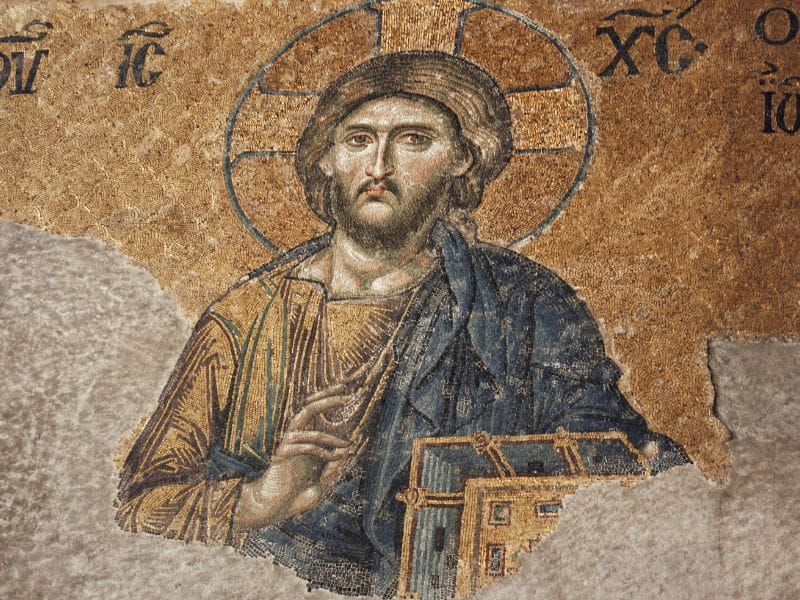
The Greek state calendar includes eleven national public holidays. Six of them are Orthodox religious feasts with direct Byzantine institutional origins: Epiphany (January 6), Clean Monday (moveable Lent start), Good Friday, Easter Sunday and Monday, Assumption of the Virgin (August 15), and Christmas.
The dates are calculated using the Julian calendar as reformed by the Byzantine church, not the Gregorian calendar. This means Greek Orthodox Easter does not coincide with Western Easter in most years.
The feast of Saint Demetrios (October 26) is a local public holiday in Thessaloniki and the regional unit of Thessaloniki — but not a national holiday.
It has been observed on this date continuously since at least the 7th century, when the Miracles of Saint Demetrios, a hagiographic text compiled in Thessaloniki, documented the feast as an established civic event.
The Dimitria cultural festival, which accompanies the feast throughout October, has its origins in the Byzantine Demetria fair — one of the most important commercial events in the medieval eastern Mediterranean. The festival’s current form was reconstituted in 1966, but its institutional ancestor is Byzantine.
Where to see the Byzantine influence in Thessaloniki directly
The Museum of Byzantine Culture on Stratou Avenue (open Tuesday to Sunday, €8 admission) provides the most systematic introduction to the Byzantine period whose influence is described in this article.
The Greek Orthodox tradition in liturgical art is on display throughout the permanent collection, particularly in Rooms 6, 10 and 11.
The first Sunday of Lent — the Feast of Orthodoxy, date varies — is the most concentrated single day for experiencing the Greek Orthodox tradition in its Byzantine liturgical form: every Orthodox church in Greece holds services commemorating the 843 AD restoration of icon veneration, and several Thessaloniki churches hold processional ceremonies.
For the urban dimension, the walk from the Roman Forum up through Ano Poli to the Byzantine walls covers the most legible sequence of Byzantine influence on the city’s physical fabric.
For the legal dimension, the National Library of Greece in Athens holds the original manuscript tradition of the Basilika, and the University of Thessaloniki’s law faculty library maintains one of the most complete collections of Byzantine legal scholarship in Greece.