
Byzantine Art: How It Changed Across Eleven Centuries, Period by Period
Table of Contents
Introduction
Byzantine art covers roughly eleven centuries, from 313 AD to 1453. It is not a single style. It is a series of distinct phases, each with its own technical priorities and political context.
The gold backgrounds most people associate with Byzantine art belong primarily to the post-iconoclast period from 843 AD onward. What came before was more variable. What came in the final two centuries was more emotionally complex.
Period 1: Early Christian Byzantine art (313–526 AD)
Early Christian art is Byzantine art in formation. It inherits classical Roman conventions — naturalistic proportion, illusionistic depth, mythological decorative motifs — and redirects them toward Christian content.
A 2nd-century Roman sarcophagus depicts figures in classical poses. A 4th-century Christian sarcophagus uses the same conventions but replaces mythological subjects with biblical scenes. The style changes slowly. The content changes immediately.
The Panagia Acheiropoietos in Thessaloniki, built around 450–470 AD, contains mosaic soffits in its nave colonnades that are among the finest surviving examples of this period. The vine scroll — a classical symbol of abundance — is reread here as a reference to Christ’s words in John 15:1.
Both visual languages inhabit the same object simultaneously. The Museum of Byzantine Culture’s Rooms 1 to 3 cover this transition in detail. Room 3 contains a 5th-century floor mosaic fragment discovered during construction in 1989. It is installed at eye level and shows the Early Christian programme fully established.
Period 2: Justinianic Byzantine art (527–726 AD)

The reign of Justinian I (527–565 AD) produced the most ambitious monumental programme in Byzantine art history. Hagia Sophia in Constantinople, completed in 537 AD, established the domed basilica as the primary form of Byzantine sacred architecture.
The Church of San Vitale in Ravenna, completed in 547 AD, contains the most complete surviving Justinianic mosaic programme. The famous panels of Justinian and Theodora show court figures combining classical frontal portraiture with the gold-ground space that would define post-iconoclast art.
In Thessaloniki, the Rotunda provides the most direct access to this period. Built under Galerius around 306 AD as a pagan structure, it was converted to a Christian church around 400 AD.
The mosaic programme in the drum of the dome — saints in architectural niches against gold backgrounds — dates primarily to the 4th and 5th centuries. These are among the earliest large-scale gold-ground mosaics in the Byzantine world. The Rotunda is open Tuesday to Sunday, 08:00 to 15:00 in winter. Entry is €6.
Period 3: The iconoclasm interruption (726–843 AD)
Iconoclasm did not stop art production entirely. It redirected it. Figurative representation of sacred subjects was banned under Leo III from 726 AD. Churches stripped of icons were redecorated with crosses, geometric patterns and landscape motifs.
Secular subjects — imperial portraits, hunting scenes — remained acceptable on non-liturgical surfaces. The iconoclast period produced significant secular output. The imperial palace in Constantinople was redecorated with classical mosaic scenes of chariot racing and hunting under Constantine V (741–775 AD).
This classicising tendency prefigures the Macedonian Renaissance’s systematic classical revival after 843 AD. The Museum of Byzantine Culture’s Room 6 covers this period through coins. Their shift from figurative to aniconic imperial portraiture between the 8th and 9th centuries is directly dateable.
Period 4: Middle Byzantine art history and the Macedonian Renaissance (843–1081 AD)

The Triumph of Orthodoxy on 11 March 843 AD ended iconoclasm and triggered an immediate expansion of icon and mosaic production. Post-iconoclast Byzantine art is more formally codified than the pre-iconoclast tradition.
The iconostasis programme — Christ Pantocrator, Virgin Hodegetria, John the Baptist, local patron saint — was standardised in this period. It became the template for Orthodox church decoration that persists today.
The Macedonian Renaissance (867–1056 AD) added a classical dimension. The Paris Psalter (Bibliothèque nationale de France, ms. gr. 139), produced around 950 AD, shows David as a classical musician surrounded by Hellenistic personifications.
The ivory Harbaville Triptych (Louvre, Paris) from the same period shows Christ flanked by saints in a composition of classical calm and technical precision. Both represent Byzantine art at its most formal and most accomplished.
In Thessaloniki, the post-iconoclast extension of the Rotunda’s mosaics and the frescoes in Ano Poli churches reflect these conventions. Rooms 6 and 7 of the Museum of Byzantine Culture cover this period in the most detail available in the city.
Period 5: Komnenian Byzantine art (1081–1261 AD)
The Komnenian period represents a shift within established conventions rather than a break from them. Figures become slightly more elongated. Drapery takes on a more dynamic quality. Faces show increased emotional engagement — not dramatic expressionism, but a controlled interiority.
The Christ of the Daphni monastery near Athens (c. 1080–1100 AD) is the defining image of this style: psychologically intense, formally perfect, and slightly unsettling in a way that Macedonian-period Pantocrators are not.
The Komnenian period also produced significant icon painting in the Sinai tradition. The monastery of Saint Catherine on Mount Sinai preserves the largest collection of pre-iconoclast and early post-iconoclast portable icons in existence.
Several Komnenian-period icons at Sinai show the period’s characteristic linear elegance and emotional restraint. In Thessaloniki, the Church of Saint Nikolaos Orphanos in Ano Poli preserves frescoes that bridge the Komnenian and Palaiologos styles.
Period 6: Palaiologos Byzantine art (1261–1453 AD) — the most expressive phase
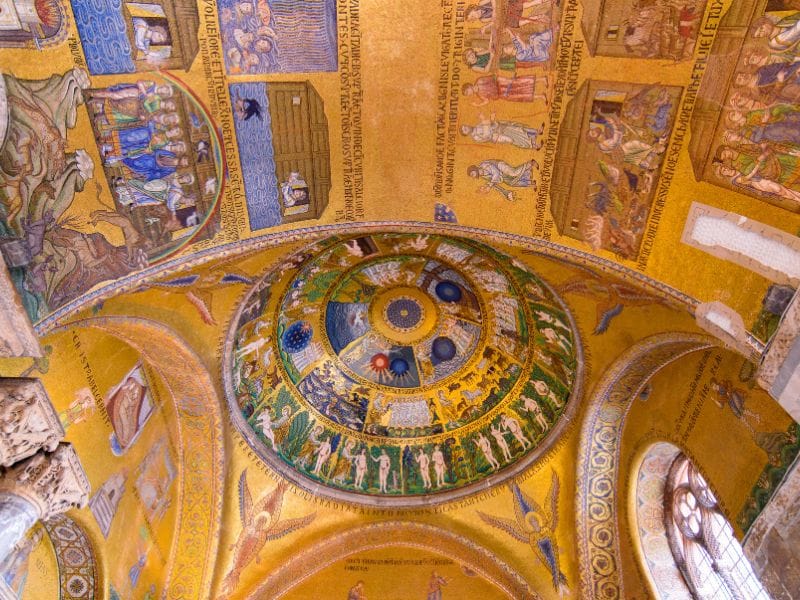
The Palaiologos period is the most visually striking phase of late Byzantine art history. Faces become more individuated. Compositions use spatial recession more actively. Figures crowd together in narrative scenes with an emotional intensity absent from earlier periods.
The frescoes at the Chora Church (Kariye Mosque) in Istanbul, executed between 1316 and 1321, are the defining works of the period. These are narrative cycles of the lives of the Virgin and Christ.
Figures lean, gesture and interact with a naturalism that led art historians from the 1920s onward to describe the style as a precursor to the Italian Renaissance. The comparison with the Italian Renaissance is contested. Palaiologos painters did not adopt linear perspective or abandon the gold background.
But the psychological complexity of the faces — visible in the Anastasis fresco at Chora, where Christ hauls Adam and Eve from their tombs with evident physical effort — represents a qualitative change from the Macedonian period’s composed restraint.
The Museum of Byzantine Culture’s Room 11 holds Palaiologos-period icons. The faces are more mobile, the colour palette warmer and more varied than earlier panels.
After 1453: the Cretan School and the survival of Byzantine art
The fall of Constantinople in 1453 did not end Byzantine art production. It relocated it. The island of Crete, under Venetian control, became the primary centre of post-Byzantine icon painting from the late 15th to the 17th century.
The Cretan School synthesised Byzantine iconographic conventions with Italian Renaissance techniques. Its most famous product is Domenikos Theotokopoulos — El Greco — who trained as an icon painter in Crete before moving to Venice and then to Toledo, Spain.
The Mount Athos monasteries in northern Greece maintained Byzantine painting traditions continuously through the Ottoman centuries.
The painter Manuel Panselinos, active in Thessaloniki and on Athos in the late 13th and early 14th centuries, is considered the founder of the Macedonian School of Byzantine painting.
His frescoes in the Protaton church at Karyes on Athos are the most cited works of this tradition. The Museum of Byzantine Culture’s Dory Papastratou Collection documents the later printed transmission of Byzantine visual culture through the 19th century.
Where to see Byzantine art in Thessaloniki: a period-by-period guide
For Early Christian Byzantine art: Panagia Acheiropoietos and Museum of Byzantine Culture Rooms 1–3. For the Justinianic period: the Rotunda. For Middle Byzantine art: Museum of Byzantine Culture Rooms 6–7.
For Palaiologos-period painting: Room 11 of the museum and the Church of Saint Nikolaos Orphanos in Ano Poli. The Museum of Byzantine Culture is the most efficient single location for following Byzantine art history from the 4th to the 15th century.