
Byzantine Fortresses: How Thessaloniki Was Defended and What You Can Still See
Table of Contents
Introduction
Thessaloniki was besieged at least seventeen times between its founding in 315 BCE and the Ottoman conquest in 1430. It survived sixteen of them. The city’s record is not explained by luck or by the quality of its soldiers alone.
It is explained by the design, construction and continuous maintenance of its fortifications across eleven centuries of Byzantine rule. The walls that still define the northern boundary of the city today are not a monument to a single defensive effort.
They are the cumulative result of repairs, reconstructions and strategic adaptations carried out under at least thirty different emperors. Byzantine fortresses were not passive barriers. They were active military systems, integrated with naval defence, signal networks, garrison logistics and a strategic doctrine codified in military manuals that Byzantine commanders were required to study.
Thessaloniki’s fortifications: key facts
Total wall circuit: approx. 8 km
Construction period: 4th to 15th century AD
Major towers: Trigonion (Chain Tower), Heptapyrgion (seven-towered citadel)
Sieges survived: 16 of 17 between 315 BCE and 1430 AD
Last major repair: 14th century under Andronikos II Palaiologos
UNESCO status: part of the Paleochristian and Byzantine Monuments of Thessaloniki (inscribed 1988)
Visitor access: Heptapyrgion open Tue–Sun 08:00–15:00, free entry / Trigonion Tower, free access
The Thessaloniki walls: eight kilometres of continuous construction

The Byzantine walls of Thessaloniki run for approximately eight kilometres around the northern and eastern perimeter of the city. The first stone circuit was built under the Roman emperor Cassander around the time of the city’s founding in 315 BCE.
This was substantially rebuilt and extended under the Emperor Theodosius I in the late 4th century AD — the same emperor who issued the Edict of Thessaloniki in 380 AD declaring Christianity the official state religion.
Subsequent repairs and extensions were carried out under Theodosius II (408–450 AD), Justinian I (527–565 AD), and multiple emperors of the Macedonian and Palaiologos dynasties.
The walls are not uniform in construction or date. Close inspection of the masonry reveals at least six distinct building phases, identifiable by changes in brick size, mortar composition, and the alternating stone-and-brick layering (opus mixtum) characteristic of different Byzantine centuries.
The section above Ano Poli, running from the Trigonion Tower westward to the Heptapyrgion, is the best-preserved and most accessible. The gradient along the wall’s inner face is moderate — approximately 6% — making it walkable for most visitors.
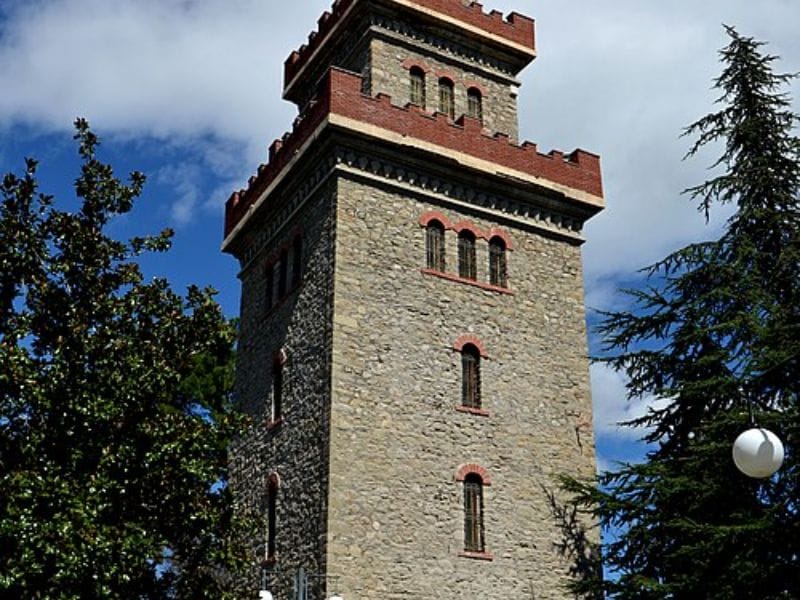
The Trigonion Tower (also called the Chain Tower) stands at the northeast corner of the upper wall circuit. It is open to visitors free of charge and provides the widest unobstructed view south across Thessaloniki to the Thermaic Gulf.
On clear days between October and April, Mount Olympus is visible at approximately 100 kilometres.
The tower takes its name from the iron chain that could be stretched across the harbour entrance to block enemy ships — a defensive measure also used at Constantinople and documented in Byzantine naval manuals.
The Heptapyrgion: seven towers and a continuous history from Rome to 1989
The Heptapyrgion — from the Greek for seven-towered — is the fortress at the northeast corner of Thessaloniki, at the highest point of the Byzantine wall circuit.
Its current form dates primarily to the 15th-century Ottoman consolidation of earlier Byzantine construction, but its foundations and lower courses incorporate masonry from the 4th century onward.
The name refers to the seven towers of the inner citadel; the total complex originally included additional outer towers along the connecting wall sections. The fortress served successive functions across its history: a Byzantine military garrison, an Ottoman administrative centre, and a prison from the Ottoman period through modern Greek history.
It operated as a prison until 1989 — within living memory — when it was finally closed and transferred to the Archaeological Service.
The prison function accounts for the relatively poor state of preservation of some interior structures: successive administrations modified the Byzantine layout for custodial use without regard for the original architecture.
Since 1989 it has been excavated and partially restored. It is open to visitors Tuesday to Sunday from 08:00 to 15:00 and entry is free.
The Theodosian Walls of Constantinople: the most effective Byzantine fortress ever built

The most important Byzantine fortress in history is not in Thessaloniki but in Istanbul. The Theodosian Walls of Constantinople, built between 408 and 413 AD under Emperor Theodosius II, protected the city for 1,040 years — from their completion until the Ottoman assault of 29 May 1453.
They were never breached by military force in that entire period. The Arab sieges of 674–678 and 717–718 AD failed. The Bulgarian siege of 813 AD failed. The Fourth Crusade’s assault in 1203–1204 succeeded not through the land walls but through the sea walls on the Golden Horn, which were less heavily defended.
The Theodosian land walls were a triple-layered system: an outer moat approximately 20 metres wide that could be flooded, an outer wall approximately 2 metres thick and 8 metres high with 96 towers, and an inner wall approximately 5 metres thick and 12 metres high with 96 additional towers offset from the outer wall so that each covered the other’s blind spots.
The total depth of the system was approximately 60 metres. No comparable defensive structure was built anywhere in Europe for another seven centuries. The walls survive substantially intact today and can be walked along their entire 6.5-kilometre length on the Istanbul side.
Greek fire: the naval weapon that protected Constantinople’s sea walls
Byzantine naval defence depended heavily on a weapon whose composition remains partially unknown: Greek fire (hygron pyr, liquid fire).
First deployed in 672 AD by the Syrian engineer Kallinikos against the Arab fleet besieging Constantinople, it was a petroleum-based incendiary mixture that burned on water and could not be extinguished by water.
It was projected through siphons mounted on Byzantine warships (dromons) and on the sea walls of Constantinople, and was also used in hand-thrown ceramic grenades.
The composition of Greek fire was a state secret. Contemporary Byzantine sources describe it as a mixture involving petroleum, quicklime and other ingredients, but the exact formula was deliberately obscured.
The Arab historian Theophanes records that the Arab fleet “was consumed and sank with all hands” at the 672–678 AD siege.
The weapon was used decisively again in 717–718 AD against a second Arab fleet and in multiple subsequent engagements. The last documented use is at the Battle of Bosporus in 941 AD against the Rus fleet of Igor of Kiev.
Byzantine strategic doctrine: defence in depth and the Strategikon
Byzantine military thinking was codified in a series of manuals that distinguished it from the simple emphasis on pitched battle characteristic of Roman military tradition.
The Strategikon, attributed to Emperor Maurice and compiled around 600 AD, is the most comprehensive surviving military manual of the ancient or early medieval world. It covers infantry and cavalry tactics, logistics, siege warfare, intelligence gathering, and — significantly — diplomatic alternatives to combat.
The manual explicitly advises commanders to avoid pitched battle when possible and to use terrain, fortification and attrition to exhaust enemies instead. The theme system, introduced under Emperor Heraclius (r. 610–641 AD) and fully developed by the 9th century, applied this doctrine at the imperial level.
The empire was divided into administrative-military districts (themes) each with its own garrison, funded by local tax revenues rather than centralised treasury transfers.
This created a layered defence-in-depth: invading forces might penetrate outer themes but would face successive fortified positions and local resistance rather than a single decisive confrontation.
Thessaloniki was the capital of the Theme of Thessaloniki from the 7th century onward. Its walls were maintained and garrisoned under this system.
The Thessaloniki walls and the Museum of Byzantine Culture: Room 8
The Museum of Byzantine Culture’s Room 8 covers Byzantine military archaeology through finds from fortified settlements across the wider region.
The collection includes iron weapons — spearheads, arrowheads, sword fragments — stone projectiles from catapult mechanisms, architectural fragments from tower constructions, and ceramic material from garrison contexts. The objects are not ornamental.
They are functional equipment for conflict, and the absence of decoration is part of their story. The room covers the period from the 7th century — when Thessaloniki survived multiple Avar and Slavic sieges documented in the Miracles of Saint Demetrios — through the Ottoman siege and capture of 1430.
For visitors who have already walked the Thessaloniki walls and visited the Heptapyrgion, Room 8 provides the object-level evidence for what those structures were designed to resist.
Visiting Byzantine fortresses in Thessaloniki: practical summary
The most efficient sequence for visiting Thessaloniki’s Byzantine fortifications is to start at the Museum of Byzantine Culture for context , then walk north through the city to the foot of Ano Poli. From there, the Heptapyrgion is a further 20 minutes uphill.
The walk along the wall from the Heptapyrgion eastward to the Trigonion Tower takes approximately 15 minutes at a moderate pace and includes the best-preserved section of the circuit. The descent back to the city centre can be made through Ano Poli’s Byzantine street network, passing the Monastery of Vlatadon and the Church of Saint Nikolaos Orphanos.
The total itinerary — museum plus walls plus Heptapyrgion — covers approximately 4 kilometres on foot and takes three to four hours including stops. Flat-soled shoes with grip are essential for the cobbled sections in Ano Poli.