
The Byzantine Museum in Thessaloniki: Six Reasons Most Visitors Skip It and Why That’s a Mistake
Table of Contents
Introduction
The Byzantine Museum on Stratou Avenue has won the Council of Europe Museum Prize — the highest recognition in European museology — and has held it longer than any other Greek institution.
It houses more than 3,000 objects across eleven rooms. Most first-time visitors to Thessaloniki walk past it on the way to the seafront.
1. It won the top prize in European museology — and almost nobody knows that
The Council of Europe Museum Prize is awarded to museums that make a significant contribution to European culture. The Museum of Byzantine Culture received it in 2001. It has retained the distinction longer than any other institution in Greece.
The same year, the building received the Aga Khan Award for Architecture in 1995 — an award given every four years to projects that serve Muslim communities and heritage. The award recognised the building’s integration of natural light, open circulation and material vocabulary drawn from Byzantine ecclesiastical construction.
These are not local or regional distinctions. They are international peer recognitions. Yet neither appears on most Thessaloniki tourism lists. The Acropolis Museum in Athens, the National Archaeological Museum, the Byzantine and Christian Museum — all receive more general coverage.
The Thessaloniki Byzantine Museum is, by institutional measure, in the same category. It simply operates in a city that international travel media covers less thoroughly.
2. The architecture is itself a significant work

Architect Kyriakos Krokos designed the building around a specific spatial argument. Natural light enters through high clerestory openings, not skylights. This produces directional illumination similar to that of Byzantine basilicas.
The circulation sequence moves from lighter to darker spaces as the collection moves from Early Christian to late Byzantine. The use of exposed concrete, brick and local stone references Byzantine construction without imitating it. The Aga Khan jury described the building as making “the past present without pretending it is the past.”
The entrance sequence — a long ramp, a compressed foyer, then a sudden opening into the first room — replicates the spatial experience of entering a Byzantine narthex before proceeding into the nave. Most visitors do not notice this consciously. They simply feel that the space works in a way that other museums do not.
3. It changes what you see in the rest of Thessaloniki
Thessaloniki has fifteen UNESCO-listed Byzantine monuments. Most visitors photograph them without knowing what they are looking at. The Byzantine Museum solves that problem directly.
It introduces the visual vocabulary — iconographic types, mosaic programmes, architectural conventions, donor portraits — that governs every Byzantine church and monument in the city. A 90-minute visit before walking to Ano Poli or the Rotunda changes the experience of both completely.
Room 6, for example, covers the iconoclasm controversy and its resolution in 843 AD. After seeing it, the post-iconoclast gold mosaics in the Rotunda are no longer just impressive decoration.
They are the physical result of a 117-year political and theological conflict. Room 9, the Byzantine household collection, makes the churches feel inhabited rather than monumental. These are the effects that no guidebook photograph can replicate.
4. It is significantly less crowded than comparable Greek museums

The Acropolis Museum in Athens received over 1.6 million visitors in 2023. The National Archaeological Museum in Athens received over 600,000. The Museum of Byzantine Culture in Thessaloniki receives approximately 120,000 visitors per year. This is not because the collection is weaker.
It is because Thessaloniki attracts fewer international tourists than Athens, and because “Byzantine culture” has less immediate recognition value for travellers unfamiliar with Greek history. The practical consequence is that you can spend 20 minutes in front of a 14th-century Palaiologos icon without anyone standing next to you.
The mosaic fragment in Room 3 — a 5th-century floor section roughly two metres wide, installed at eye level — is rarely crowded even in summer. This is unusual for an object of this quality and rarity. At comparable institutions in Athens or Istanbul, it would require a timed ticket.
5. It belongs on any serious list of what to do in Thessaloniki
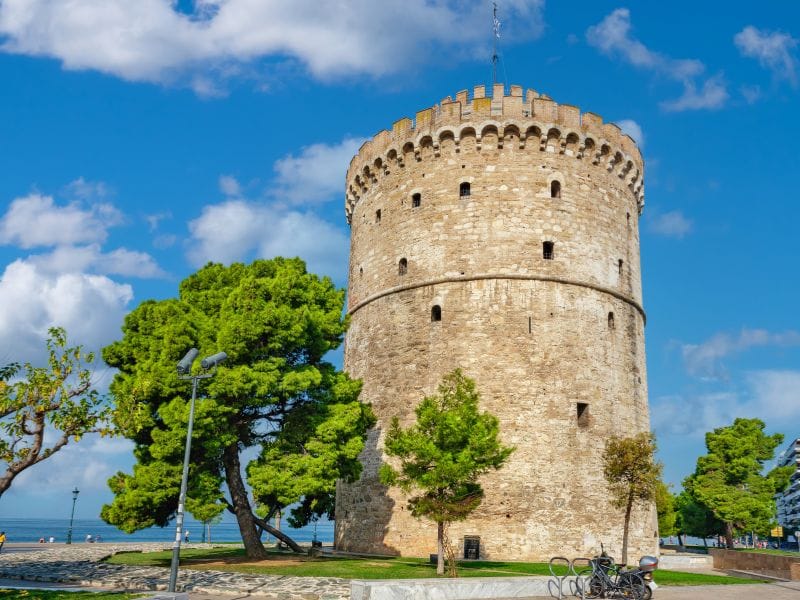
Most Thessaloniki itineraries prioritise the White Tower, the seafront promenade, Aristotelous Square and the market district. These are all worth visiting. But what to do in Thessaloniki for visitors with more than two days typically involves working through the city’s Byzantine layer — and the museum is the most efficient introduction to that layer available.
The combined ticket covering the Byzantine Museum, Archaeological Museum, White Tower and Rotunda costs €15 and represents the clearest cultural itinerary the city offers. The museum sits on Stratou Avenue, 12 minutes on foot from Aristotelous Square along the seafront.
It is 200 metres from the Archaeological Museum. Both are directly on the route between the city centre and the Concert Hall at the eastern end of the waterfront. Adding both museums to a morning already planned around the seafront requires no additional transport and adds approximately three hours.
6. The two collections most visitors walk past are genuinely rare
Adjacent to Room 11, two private collections are included in the standard admission ticket but are easy to miss.
The Dory Papastratou Collection holds approximately 800 religious prints from the 17th to 19th centuries — woodcuts, engravings and lithographs printed in Venice, Vienna, Leipzig and Constantinople for Orthodox communities across Europe and the Middle East.
These objects document how Byzantine visual culture was transmitted through print technology after the fall of the empire. No comparable collection is publicly accessible in Greece. The Dimitrios Oikonomopoulos Collection covers liturgical manuscripts and Byzantine musical notation through 18th and 19th-century choir books.
It is one of the few accessible collections in Greece that bridges medieval Byzantine chant notation and the modern Orthodox liturgical tradition. Both collections are signposted from Room 11. Both are worth the detour. Most visitors leave the museum without knowing either exists.
Who should visit and who can skip it
The Byzantine Museum is not for everyone. Visitors on a half-day itinerary focused on the White Tower and the waterfront can reasonably leave it out.
The same applies to visitors travelling with young children who have limited museum tolerance — though the museum’s family guide and the Room 9 toy collection make it more accessible to children aged five and above than most comparable institutions.
It is directly relevant for visitors who plan to spend time in Thessaloniki’s Byzantine churches — particularly Agios Nikolaos Orfanos, the Rotunda or the Panagia Acheiropoietos. It is relevant for anyone deciding what to do in Thessaloniki over more than two days.
And it is relevant for visitors with an interest in art history, medieval history or Orthodox Christianity who would find the Benaki Museum’s Byzantine collection or the Byzantine and Christian Museum in Athens worth visiting. By any of those measures, this museum belongs in the first tier of the city’s cultural itinerary.