
Discovering Byzantium in Thessaloniki
Table of Contents
Discovering Byzantium in Thessaloniki While Wandering the City
You don’t always need a map to touch the past. In Thessaloniki, Byzantium in Thessaloniki reveals itself while you simply move through the streets. It lives beyond museum walls and famous basilicas, in the worn stones underfoot, in quiet courtyards hiding behind apartment entrances, and in fragments of walls peeking out beside cafés.
To explore Byzantium in Thessaloniki is less about ticking off monuments and more about letting the city unfold naturally. Walk long enough and you begin to sense it — the layered memory that turns ordinary corners into accidental encounters with history.
Why Thessaloniki Feels Like an Open-Air Byzantine Museum
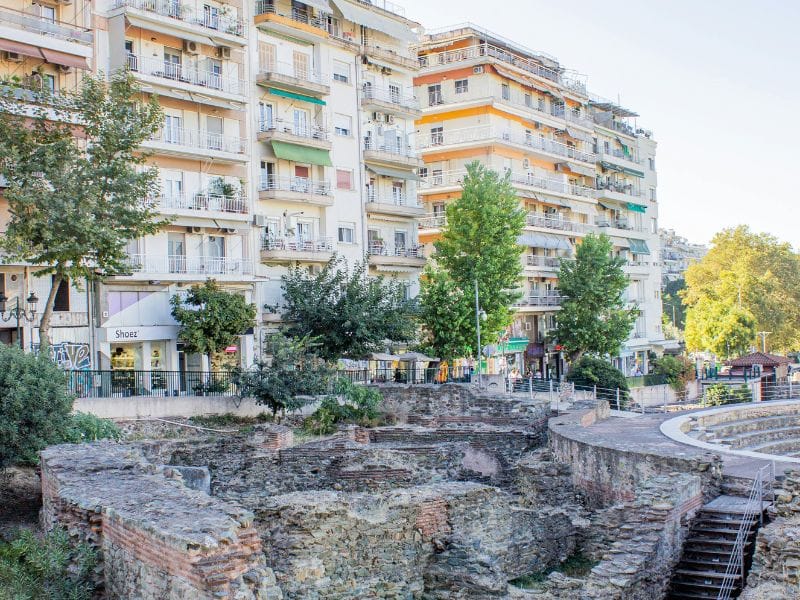
For over a thousand years, Thessaloniki stood at the heart of the Byzantine world. Second only to Constantinople in importance, it served as a fortress city, administrative hub, and deeply spiritual center of Orthodox Christianity.
That long continuity never vanished — it simply blended into daily life.
Unlike cities where ancient remains sit safely behind fences, Byzantium in Thessaloniki flows through modern neighborhoods. Churches stand beside shops, medieval walls rise behind residential balconies, and mosaics survive only steps away from busy traffic. History here does not isolate itself — it walks side by side with the present.
Wandering Without a Plan
The most genuine way to encounter Byzantium in Thessaloniki is sometimes to ignore itineraries altogether. Begin at the seafront. Let the breeze guide you northward. Follow narrow streets uphill without worrying where they lead. Somewhere along the way, discovery happens naturally.
Perhaps you turn a corner and step into the shadow of a tiny 11th-century chapel whose frescoes catch the sunlight. Or you notice a stone cross worn nearly smooth by centuries of touch. Or you glimpse mosaic fragments behind an iron gate in someone’s courtyard.
In Thessaloniki, the Byzantine world is never far away — even when you’re simply heading out for coffee.
Seven Byzantine Landmarks You Might Stumble Upon
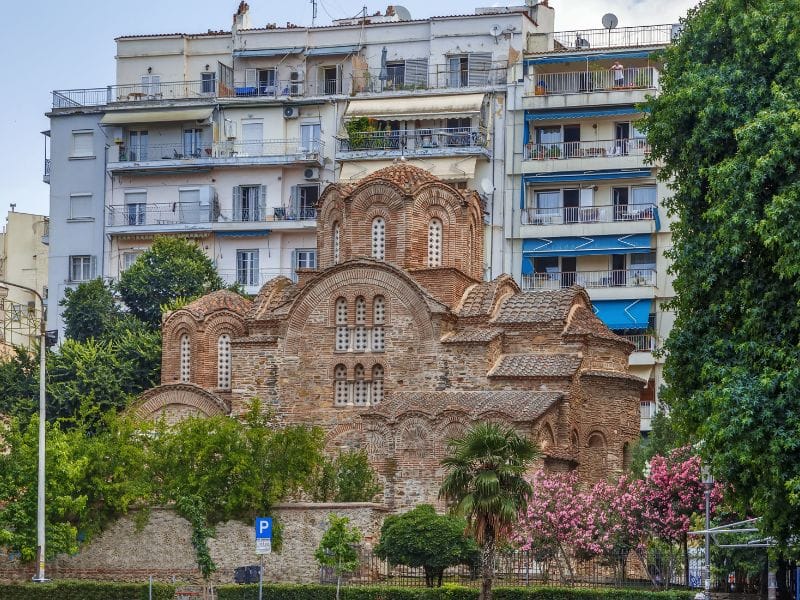
While wandering, you may find yourself unexpectedly face to face with some of the city’s enduring Byzantine treasures.
Hagia Sophia rises quietly near the city center. Built in the 8th century and inspired by its Constantinopolitan namesake, its vast dome shelters shimmering mosaics that offer calm amid surrounding movement.
Just around the Roman Agora stands Panagia Chalkeon, known as the “Red Church”. Constructed entirely in brick, its warmth contrasts beautifully with the urban bustle outside its walls.
Close to Aristotelous Square, the basilica of Acheiropoietos preserves 5th-century Christian art among the oldest surviving examples in Greece, often overlooked by passersby unaware of its age.
In the heights of Ano Poli, the Byzantine Walls still stretch across hillsides. Once guarding the empire’s northern frontier, they now offer panoramic views over the modern city below.
Hidden deep in twisting lanes waits Hosios David, or the Latomou Monastery. Inside lies an extraordinary 6th-century mosaic of Christ — uncovered only in modern times after centuries concealed beneath plaster.
Near busy road junctions sits the Church of Saint Panteleimon, a 14th-century sanctuary that once formed part of a larger monastery complex.
Scattered discreetly along Agiou Dimitriou Street, tiny chapels cling to the sidewalk edge. Often unmarked on tourist maps, these modest sanctuaries — some no wider than a car lane — quietly continue their role as anchors of local devotion.
Noticing Byzantium in Small Details
Even without stepping inside a single church, Byzantium in Thessaloniki still makes itself visible.
Look closely and you’ll notice decorative stone arches above doorways, Greek inscriptions carved directly into steps, and reused marble columns built into newer façades. Icons glow softly behind glass windows of neighborhood shops. Elderly locals cross themselves in passing as they walk past hidden shrines.
These almost invisible gestures form the “quiet grammar” of Byzantium — not staged history but living continuity.
The City as a Storybook

Walking through Thessaloniki feels like leafing through a book with no page numbers. Each block opens a new chapter, each alley raises new questions.
Who built this fragment of wall?
Why does that church sit lower than street level?
Which saint once prayed in that courtyard?
What was destroyed — and what somehow survived?
With modern apps, audio guides, and QR plaques appearing more frequently across the city, exploring Byzantium in Thessaloniki has never been more accessible — even for travelers without a background in history.
But curiosity remains your best guide. Questions are what unlock the city’s deeper layers.
Final Thoughts — Letting Thessaloniki Reveal Itself
You don’t need academic training to experience Byzantium in Thessaloniki. You only need awareness.
Pause when something catches your eye. Follow side streets that look unimportant. Listen to stories shared by café owners or shopkeepers. Let the city slow you down.
You may find:
– A chapel unlocked for no reason other than quiet faith.
– A mosaic glowing unexpectedly in morning sun.
– A local recounting a dream of the Virgin Mary as if it were yesterday.
In Thessaloniki, Byzantium isn’t frozen in the past.
It walks beside you.