
Day Trip to Vergina: The Royal Tombs of Aigai, How to Get There, and What to Expect
Table of Contents
Introduction
A day trip to Vergina puts you inside a 2,300-year-old royal burial mound 70 kilometres west of Thessaloniki, where the gold funerary objects of Philip II of Macedon — father of Alexander the Great — remain on display in the exact chambers where archaeologist Manolis Andronikos found them in 1977.
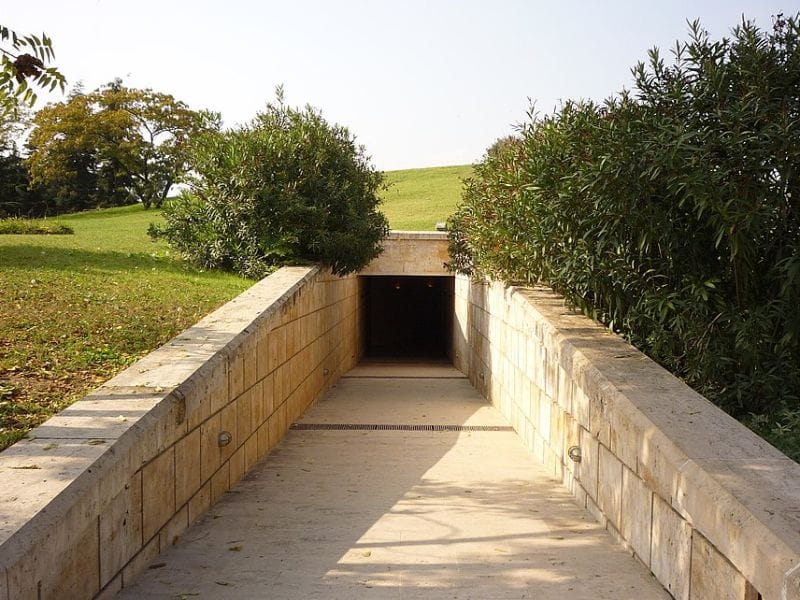
The Museum of the Royal Tombs of Aigai, built beneath the Great Tumulus at the edge of the modern village of Vergina, is one of the few sites in Greece where the find context, the objects and the original location are preserved together without reconstruction.
The site is open daily, admission costs €15 for adults and is free for visitors under 18, and the drive from Thessaloniki takes between 55 and 70 minutes by car. A 90-minute visit covers the essential tombs and the main collection.
What follows is a practical guide to the site itself, the three realistic transport options from Thessaloniki, and the optional additions — Veria and the Byzantine Museum — that turn a half-day excursion into a full day in northern Greece.
What you are visiting: Aigai and the discovery of 1977

Aigai was the first capital of the Macedonian kingdom and its royal burial ground for several centuries, even after the capital moved to Pella in the 4th century BCE. The Great Tumulus — the burial mound beneath which the museum is built — is approximately 110 metres in diameter and 12 metres high, constructed over a series of royal tombs dating from the late 4th century BCE.
The mound had been visible in the landscape since antiquity, but its contents were unknown until Andronikos began systematic excavation in 1976. In November 1977, Andronikos’s team opened Tomb II and found it unlooted: a gold larnax containing cremated remains, a gold oak-leaf diadem with 313 individual leaves, ceremonial armour, ivory portrait miniatures and hundreds of additional objects.
The skeletal analysis, the armour design and the portrait miniatures all supported the identification of the tomb’s occupant as Philip II, assassinated in 336 BCE. A second tomb in the same mound, containing a gold larnax with a Macedonian star and a woman’s diadem, is now believed to hold Philip III Arrhidaeus and his wife Eurydice.
Inside the museum: what to see and in what order

The museum entrance leads underground into a temperature-controlled space built within the tumulus itself. Ambient lighting is kept intentionally low — around 50 lux in the main galleries — to preserve the original tomb paintings and to create viewing conditions close to those of the original burial chambers. Allow a few minutes for your eyes to adjust before moving into the main hall.
The audio guide, available in Greek and English for €3 at the entrance, is worth taking: the site’s layout is not always self-explanatory without context. The first major stop is the façade of Tomb II, preserved intact behind glass. The painted hunting frieze above the entrance — showing mounted hunters pursuing lions and boars — is one of the best-preserved examples of large-scale ancient Greek painting in existence.
The gold larnax and diadem from Tomb II are displayed in the antechamber at eye level, approximately 1.5 metres from the viewing position. The larnax bears the 16-point Macedonian star on its lid and weighs 11 kilograms; the diadem’s 313 oak leaves and 68 acorns are individually cast in gold.
he Tomb of Persephone, the oldest tomb in the group (late 4th century BCE), is visible through a protective window rather than accessible directly. Its wall paintings — showing the abduction of Persephone by Hades — are considered the earliest known example of shading technique (skiagraphia) in Greek painting, predating the Pompeii frescoes by roughly three centuries.
Photography is permitted without flash in most sections; tripods are not allowed.
Getting to Vergina from Thessaloniki: car, public transport and organised tours
The fastest and most flexible option is driving. From Thessaloniki city centre, take the E90 motorway westbound toward Veria; the journey covers approximately 65 kilometres on the motorway plus 10 kilometres on the regional road from the Veria exit to the site. Toll charges on the E90 are approximately €2.20 each way. Parking at Vergina is free and ample even in summer. GPS coordinates for the site entrance: 40.4876° N, 22.3175° E.
How to turn the day trip to Vergina into a full day in northern Greece
The Royal Tombs alone justify the journey, but two additions extend the day without adding significant complexity. The first is Veria, 12 kilometres northwest of the site on the return route to Thessaloniki.
Veria was ancient Beroia, where the Apostle Paul preached in approximately 50 AD; the city retains approximately 50 surviving Byzantine churches in its historic centre — an unusually high concentration — plus the Tribune of Paul, an open-air monument on Anixeos Street marking the traditional preaching site, accessible without charge. A 45-minute stop is enough to see the tribune and one or two churches.
The second option, for visitors already based in Thessaloniki, is to begin the day at the Museum of Byzantine Culture on Stratou Avenue before departing for Vergina. The Byzantine Museum opens at 08:00 and a 90-minute visit covers the essential rooms; departing Thessaloniki by 10:30 still places you at the Vergina site before noon.
This sequence moves backwards through history — from the 15th-century Byzantine period in the morning to the 4th-century BCE Macedonian period in the afternoon — but it keeps the logistically simpler site (the city museum) in the morning slot and the site requiring a drive in the afternoon.
Practical notes before you go
Food options at the site itself are limited. The entrance kiosk sells water, coffee and packaged snacks; a small taverna adjacent to the site entrance serves simple Greek food at lunch hours but is not reliably open outside May through September. Packing lunch or eating in Veria before or after the visit is the safer option, particularly for groups with children.
Veria’s covered Elia market and the main pedestrian street (Mitropoleos) have multiple restaurants and cafes open throughout the year. Online pre-booking through aigai.gr is advisable during July and August, when the site operates a timed-entry system and walk-in availability on weekends can be limited. Outside peak season, tickets are available at the entrance without advance booking.
The museum interior is fully wheelchair accessible; the exterior tumulus path has an uneven gravel surface and is not suitable for pushchairs. The site maintains a coat-check at the entrance; large bags are not permitted in the galleries.