
Iconoclasm: Why Byzantium Banned Its Own Sacred Images and What Happened When They Returned
Table of Contents
Introduction
In 726 AD, Emperor Leo III ordered the removal of a large icon of Christ from the Chalke Gate — the ceremonial entrance to the imperial palace in Constantinople. The official who climbed the ladder to carry out the order was killed by a crowd of women who pulled him down.
This single incident encapsulates the two dimensions of Byzantine iconoclasm that are easy to miss when the controversy is described purely as a theological dispute: it was also a conflict over political authority, and its opponents were prepared to use physical force.
Iconoclasm — from the Greek εικονoκλάστες, image-breakers — ran in two distinct phases separated by a fifty-year interval of icon restoration. The first phase lasted from 726 to 787 AD; the second from 815 to 843 AD.
Together they constitute 117 years of intermittent imperial policy that destroyed an unknown but large number of icons, frescoes and mosaics, forced the exile or execution of hundreds of monks and clergy who refused to comply, and produced a body of theological argumentation in defence of images that remains the foundation of Orthodox icon theology today.
The icons you see in Thessaloniki’s churches and in the Museum of Byzantine Culture are the survivors and the successors of that crisis.
Why iconoclasm started: theology, politics and military pressure

Leo III’s decision to ban icons in 726 AD had at least three distinct motivations, and historians continue to debate their relative weight.
The theological argument — that depicting Christ in material form risked confusing the divine and human natures, or that the veneration of images constituted idolatry prohibited by the Second Commandment — was genuine and had been a minority position within Christianity since the 3rd century.
The political argument was equally real: Leo III had recently suppressed a serious military revolt and needed to assert authority over the Church, which had accumulated significant institutional independence during the 7th century’s political chaos.
The third factor was external: the Arab caliphate, which had conquered large territories from the Byzantine Empire in the previous century, practised strict aniconism, and some Byzantine commentators argued that Christian military defeats were divine punishment for idolatry.
The Council of Hieria in 754, convened by Constantine V — the most doctrinally committed of the iconoclast emperors — attempted to provide iconoclasm with a formal theological basis by ruling that the only legitimate image of Christ was the Eucharist.
The council was attended by 338 bishops but notably by no representative of any of the four eastern patriarchates (Alexandria, Antioch, Jerusalem, Constantinople) or of the papacy, a procedural deficiency that pro-icon theologians later used to argue its decisions had no canonical validity.
Constantine V subsequently intensified persecution: the monk Stephen the Younger was executed in 764 AD after refusing to deny the legitimacy of icons, and dozens of monasteries in Constantinople were converted to barracks or secular use.
The theologians who defended icons: John of Damascus and Theodore the Studite
The two most important defenders of icons wrote from very different positions. John of Damascus (c. 675–749 AD) was a senior official in the Umayyad caliphate’s administration in Damascus — a position that placed him outside Byzantine imperial jurisdiction and therefore safe from Leo III’s reach.
Writing between approximately 726 and 749 AD, he produced three Treatises in Defence of the Holy Icons that established the theological framework that ultimately prevailed: the distinction between latreia (worship due to God alone) and proskynesis (veneration appropriate to images and relics).
Also the argument that the Incarnation — God taking material form in Christ — had permanently sanctified the representation of the divine in matter, and the principle that veneration of an image passes through to the person depicted rather than terminating at the physical object.
Theodore the Studite (759–826 AD) led the monastic resistance during the second iconoclast phase from the Stoudios Monastery in Constantinople.
His contribution was less systematic than John of Damascus’s and more directly polemical: hundreds of letters to monks, clergy and laypeople across the empire urging resistance, and a series of public confrontations with iconoclast authorities that resulted in his exile three times and in flogging.
Theodore’s letters document in unusual detail the practical experience of iconoclasm at community level: the pressure on individual monks to sign compliance documents, the social fractures within monastic communities divided between iconoclasts and iconophiles, and the specific tactics used by imperial officials to enforce compliance without provoking the kind of violent resistance that had attended Leo III’s 726 order.
The Triumph of Orthodoxy: 11 March 843 AD and its aftermath

The second iconoclast phase ended not through military defeat or theological persuasion but through a change of imperial regent. When Emperor Theophilos died in January 842 AD, his widow Theodora assumed the regency for their three-year-old son Michael III.
Within months, she had convened a synod in Constantinople that condemned iconoclasm and reinstated the Patriarch Methodios, who had been imprisoned for his pro-icon stance.
The formal restoration took place on the first Sunday of Lent, 11 March 843 AD, in a ceremony at the Church of Hagia Sophia in Constantinople in which icons were processed through the building and reinstated in their positions.
The date was immediately designated as an annual feast — the Triumph of Orthodoxy, or Kyriaki tis Orthodoxias — which has been observed on the first Sunday of Lent in every Orthodox church worldwide without interruption since 843 AD.
The Triumph of Orthodoxy had immediate material consequences in Thessaloniki. Churches that had been stripped of figurative decoration during the iconoclast periods were systematically repainted and remosaiced.
The mosaic programme in the Rotunda, parts of which date to the 4th and 5th centuries but which were significantly extended in the post-843 period, reflects this restoration and expansion.
The gold-ground mosaic fragments visible today in the Rotunda’s drum — saints in architectural niches against gold backgrounds — belong partly to the pre-iconoclast tradition and partly to the post-843 revival.
The distinction is not always visible to the non-specialist eye, but the Museum of Byzantine Culture’s Room 6 explains the archaeological evidence through dateable objects from both periods.
What iconoclasm actually destroyed and what survived
The scale of iconoclast destruction is genuinely difficult to assess because its most thorough practitioners destroyed not only images but the documentary records of their destruction.
What is certain is that the pre-iconoclast period in Constantinople produced a rich tradition of portable icons, monumental mosaic programmes and painted church interiors, of which almost nothing survives in Constantinople itself — the combination of iconoclast destruction, the Latin sack of 1204 and the Ottoman conquest of 1453 has left the Byzantine capital’s pre-iconoclast artistic heritage almost entirely lost.
Thessaloniki, which was less thoroughly affected by iconoclast enforcement than the capital and was never sacked by the Latins, preserves a higher proportion of surviving pre-iconoclast material than any other city in the former Byzantine world.
The Panagia Acheiropoietos on Agios Dimitrios Street — a 5th-century basilica built before the iconoclast controversy — retains mosaic soffits in its nave colonnades that are among the few surviving examples of pre-iconoclast figurative decoration in a major Byzantine church.
They escaped destruction partly because Thessaloniki was under Arab siege during part of the first iconoclast phase (the Arab naval attack of 904 AD falls between the two phases) and the city’s defences required full administrative attention.
The survival is documented in the Miracles of Saint Demetrios, the hagiographic text compiled in the 7th century, which records the city’s repeated deliverances from siege and provides the most detailed account of Byzantine Thessaloniki’s daily life available from the pre-iconoclast period.
How iconoclasm shaped Byzantine art after 843 AD
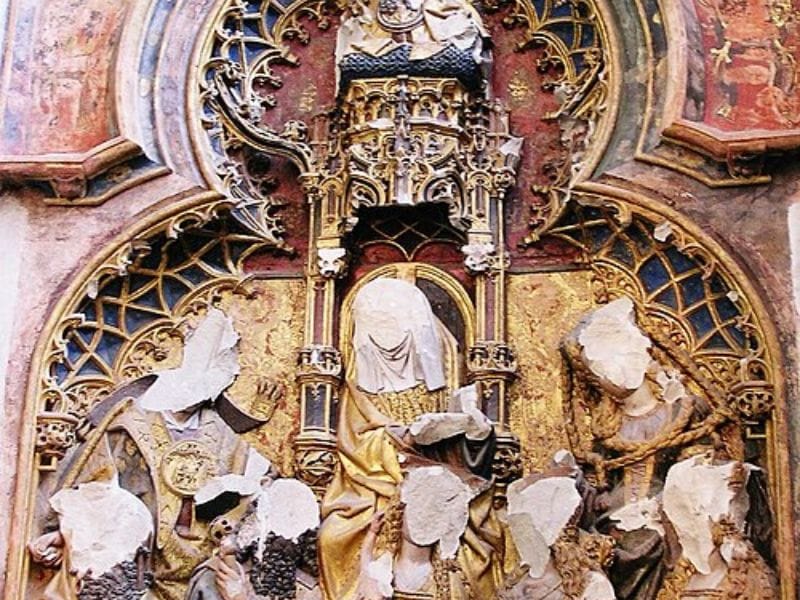
The most durable consequence of iconoclasm for Byzantine art was the standardisation of iconographic types that followed the Triumph of Orthodoxy. Before 726 AD, Byzantine icon production was relatively variable: artists experimented with composition, colour and the degree of naturalism in figural representation.
After 843 AD, the theological seriousness with which icon production was now approached — icons were now formally defined as primary theological documents, not merely devotional aids — produced a rapid codification of types, gestures and compositional conventions.
The iconostasis programme that standardises the arrangement of Christ Pantocrator, Virgin Hodegetria, John the Baptist and the local patron saint on the screen between nave and sanctuary in every Orthodox church derives directly from the post-843 settlement.
The paradox of iconoclasm is that the attempt to eliminate images produced a more coherent and durable image tradition than had existed before. The theological arguments that John of Damascus and Theodore the Studite developed in defence of icons gave post-843 production a precision and intentionality it had previously lacked.
This is why Byzantine art after 843 looks more consistent than before it — not because artistic creativity was suppressed, but because the iconographic programme was now theologically explicit in ways it had not been required to be when its legitimacy was uncontested.
The icons in the Museum of Byzantine Culture’s Rooms 6 and 11 illustrate both sides of this shift across a sequence of dateable objects that spans the iconoclast crisis from the 8th to the 15th century.
Where to see the evidence of iconoclasm in Thessaloniki
The Museum of Byzantine Culture’s Room 6 is the most systematic presentation of iconoclasm and its aftermath available in the city.
It covers the controversy through coins — whose shift from aniconic to figurative imperial portraiture between the 8th and 9th centuries is directly dateable — small devotional panels, ivory carvings and documentary evidence for icon production and destruction.
The room’s interpretive labels are among the clearest in the museum and are worth reading in full rather than skimming. The Triumph of Orthodoxy is observed in Thessaloniki as in every Orthodox church on the first Sunday of Lent — a date that falls between mid-February and late March depending on the year.
The service at the Basilica of Agios Dimitrios and at Agia Sophia typically includes a procession of icons through the nave, replicating the original 843 ceremony at reduced scale.
For visitors in Thessaloniki during this period, attending the Orthros and Divine Liturgy on this Sunday provides direct experiential context for the iconoclasm controversy that no museum visit can fully replicate: you are watching a ceremony that was designed in 843 AD specifically to mark the end of 117 years of intermittent icon destruction, and that has been performed continuously in this form for 1,183 years.