
Inside the Museum of Byzantine Culture in Thessaloniki: What You’ll Actually See
Table of Contents
Museum of Byzantine Culture in Thessaloniki: A Museum That Feels Like a Byzantine Journey
From the moment you step inside, this is not a typical museum. Soft light filters through narrow openings, brick and marble walls glow quietly, and the space unfolds like a sequence of sacred pauses. The building itself — designed by Kyriakos Krokos — prepares you for what comes next: not just history, but an experience shaped by light, silence, and movement .
Instead of overwhelming you with objects, the Museum of Byzantine Culture in Thessaloniki guides you gently through time. Each room feels intentional, almost ritualistic. By the time you reach the first exhibits, you’re already thinking differently — slower, more observant.
The Birth of Byzantine Art: Early Christian Treasures
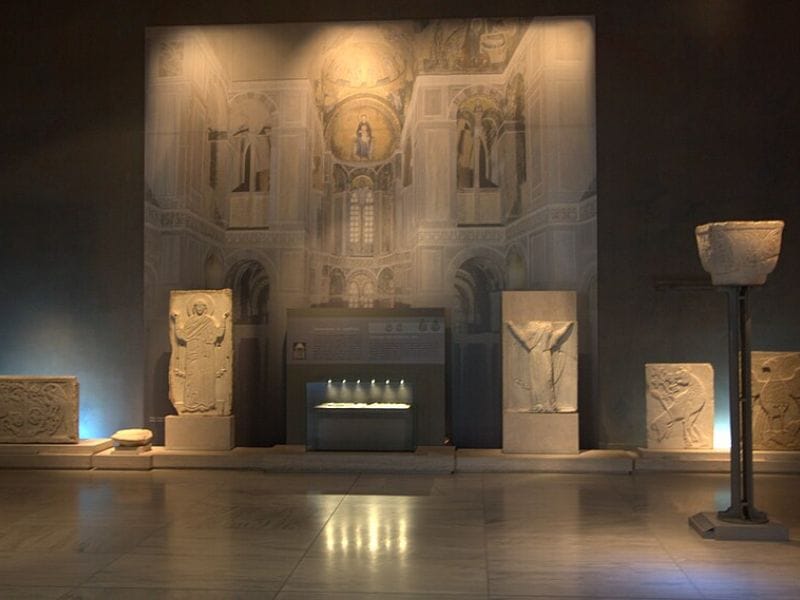
The journey begins with the foundations of Byzantine art. Here you’ll see fragments of early Christian basilicas — marble panels, carved capitals, and mosaic floors that once reflected candlelight.
These objects are not just decorative; they were part of a new visual language where faith was expressed through symbols: vines, crosses, doves, and geometric harmony . Even in fragments, these pieces carry presence. They show the moment when Christianity moved from private belief to monumental expression.
Everyday Life in Byzantium

One of the most surprising parts of the Museum of Byzantine Culture in Thessaloniki is how human it feels.
Beyond religion and emperors, you’ll step into the daily life of Byzantine Thessaloniki. A reconstructed dining room (triclinium), household objects, amphorae, glassware, jewelry — all revealing a world of trade, comfort, and social ritual .
Details stand out:
- worn handles from constant use
- delicate gold earrings blending fashion and faith
- objects that traveled across the Mediterranean
This is where Byzantium stops being abstract — and becomes real.
Death, Memory, and the Idea of Paradise
One of the most atmospheric sections explores how Byzantines understood death. Marble tombstones, inscriptions, and sarcophagi carry messages that feel strikingly modern:
“Peace to her soul.”
“He sleeps in Christ.”
The imagery blends ancient and Christian ideas — from Elysian fields to Paradise. Symbols like the Good Shepherd or doves transform grief into hope. It’s a quiet but powerful reminder: this civilization was deeply concerned with meaning, not just legacy.
The Return of Icons After Iconoclasm

After a period when religious images were banned, art returns — and it returns with intensity. Icons, ivory carvings, and small devotional objects mark this revival. Faces become more expressive, more intimate. These are not just religious images; they are declarations of survival .
This section is essential if you want to understand why icons matter so much in Orthodox culture today.
Emperors, Power, and Symbolism
Byzantium was not only spiritual — it was also political.Coins, seals, and inscriptions show how emperors projected authority across vast distances. Small objects carried big messages: legitimacy, divine protection, continuity .
You’ll notice how often religion and power overlap. In Byzantium, ruling was never just administrative — it was symbolic.
Life Behind the Walls: The Byzantine Castle
This section shifts tone. Stone, iron, and fragments of fortifications tell the story of defense and survival. Weapons, tools, and everyday objects from fortified settlements reveal something unexpected: castles were not just military sites, but living communities . It’s a more grounded, almost raw side of Byzantium — far from gold and mosaics.
The Final Centuries of Byzantium
As the empire declines, the art becomes more emotional. Icons from the 14th and 15th centuries feel deeply human — expressive faces, softer forms, less focus on imperial grandeur. Beauty doesn’t disappear; it transforms .This is one of the most memorable parts of the museum, precisely because it feels so personal.
Byzantium After Byzantium
Even after the fall of the empire, its artistic language continues. Post-Byzantine icons, manuscripts, and workshops from Mount Athos and Crete show continuity rather than collapse.
You’ll notice subtle Western influences, but the core identity remains intact . This section connects directly to modern Greek culture — and explains why Byzantium still matters today.
Unique Collections You Shouldn’t Miss
Two collections stand out:
The Dory Papastratou Collection
Religious prints once owned by everyday people — portable faith, accessible and deeply personal.
The Dimitrios Oikonomopoulos Collection
Manuscripts, hymnals, and liturgical objects preserving the sound and written tradition of Orthodoxy .
These sections feel more intimate — less about empire, more about memory.
Is the Museum of Byzantine Culture in Thessaloniki Worth Visiting?
Yes — especially if you want more than just sightseeing. This is not a museum you rush through. It’s one you experience. Compared to more crowded attractions in Thessaloniki, Museum of Byzantine Culture in Thessaloniki offers something rare: space, clarity, and narrative. If you’re even slightly interested in history, art, or culture, it’s one of the most rewarding stops in the city.