
Museum of Byzantine Culture of Thessaloniki: A Room-by-Room Guide to the Collection
Table of Contents
Introduction
TheMuseum of Byzantine Culture of Thessaloniki won the Council of Europe Museum Prize in 2001 — an award it has held longer than any other Greek institution — and houses more than 3,000 objects across eleven thematic rooms covering the period from Early Christian Thessaloniki in the 4th century to the post-Byzantine workshops of Mount Athos and Crete in the 16th and 17th centuries.
The building, designed by architect Kyriakos Krokos and opened in 1994, received the Aga Khan Award for Architecture in 1995 for its integration of natural light, open circulation and material vocabulary drawn from Byzantine ecclesiastical construction.
What follows is a room-by-room account of the permanent collection, written for visitors who want to understand what they are looking at before or after they see it.
The museum’s thematic organisation — rooms grouped by period, function and material type rather than by strict chronology — means that navigating the collection without prior context is possible but significantly less rewarding than arriving with a working knowledge of what each section covers and why it matters.
The building: why the architecture matters before you enter

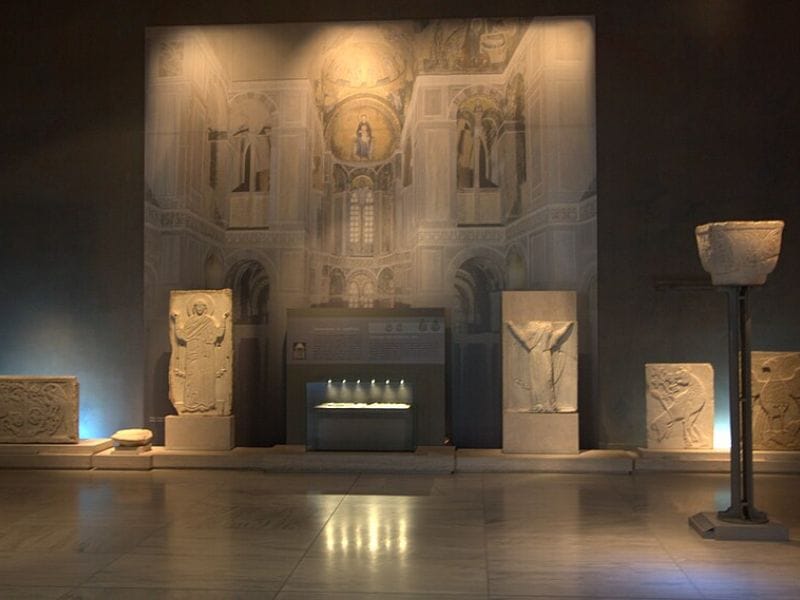
Kyriakos Krokos designed the Museum of Byzantine Culture of Thessaloniki around three principles that directly affect how the collection reads: natural light introduced through high clerestory openings rather than skylights, producing a directional illumination similar to that of Byzantine basilicas.
A circulation sequence that moves visitors from lighter to darker spaces as the collection moves from Early Christian to late Byzantine, mirroring the historical narrowing of the empire; and the use of exposed concrete, brick and local stone that references Byzantine construction materials without attempting pastiche.
The Aga Khan jury in 1995 cited specifically the building’s ability to “make the past present without pretending it is the past.” The Museum of Byzantine Culture ofThessaloniki covers approximately 3,000 square metres of exhibition space across two main levels, with additional storage and conservation facilities below grade.
The entrance sequence — a long approach ramp, a compressed entrance foyer, then a sudden expansion into the first room — is deliberate: it replicates the spatial experience of entering a Byzantine narthex and proceeding into the nave. Understanding this is useful because several reviewers have described the museum as “cold” or “sparse”; it is neither, but it does demand a slower pace than most contemporary museums encourage.
Rooms 1–3: Early Christian Thessaloniki (4th–6th century)
The first three rooms establish Thessaloniki’s role as a major centre of Early Christian art production and ecclesiastical construction. Room 1 covers the transition from pagan to Christian visual culture through architectural fragments — carved marble capitals, column bases, opus sectile floor panels — salvaged from basilicas demolished or damaged by earthquake, fire and the 1917 disaster.
The shift in iconographic vocabulary from classical to Christian is legible in the objects themselves: acanthus leaves give way to vine scrolls; eagles to doves; portrait busts to the Chi-Rho monogram.
Room 3 contains the museum’s single most immediately impressive object: a floor mosaic fragment approximately two metres wide and 1.4 metres deep, recovered from a 5th-century basilica in the Thessaloniki city centre during construction works in 1989.
The fragment is installed at floor level behind glass, allowing visitors to approach it at eye height.
The design — geometric interlace borders framing stylised birds and floral medallions in white, ochre and deep red tesserae — is consistent with mosaic programmes documented at Ravenna and Rome in the same period, confirming Thessaloniki’s position within a Mediterranean-wide Christian artistic network rather than a regional backwater.
Rooms 4–5: funerary practice and Byzantine daily life

Room 4 addresses Early Christian and Byzantine funerary practice through a collection of marble sarcophagi, tombstone inscriptions, grave goods and clay oil lamps deposited with the dead.
The inscriptions — displayed with transliterations and translations in both Greek and English — include several that record the names, occupations and family relationships of ordinary Thessaloniki residents from the 4th to the 6th century: a merchant, a craftsman’s wife, a soldier.
These objects are among the few in the entire collection that name private individuals rather than saints or emperors, and they are worth reading slowly. Room 5 contains the museum’s reconstruction of a Byzantine triclinium — a formal dining room — based on archaeological evidence from Thessaloniki excavations and from descriptions in Byzantine literary sources.
The reconstruction includes a low table (trapeza), reclining dining couches (klinai), ceramic and glass vessels, and bronze lighting equipment. The purpose is pedagogical rather than aesthetic: to show visitors how material culture functioned in a domestic setting rather than in isolation behind glass.
The room also contains the museum’s strongest collection of late Roman and Early Byzantine glassware, including intact blown-glass vessels from 4th and 5th-century Thessaloniki workshops.
Rooms 6–7: Middle Byzantine period and the aftermath of iconoclasm
Room 6 addresses the iconoclastic controversy (726–843 AD) and its resolution, through a sequence of objects that illustrates the suppression and subsequent revival of figurative religious art.
The room’s central argument — made through coins, seals, ivory carvings and small devotional panels — is that the Triumph of Orthodoxy in 843 was not simply a theological event but a material one: it produced an immediate and documented proliferation of icon production across the Byzantine world, including in Thessaloniki.
The coins are particularly useful for non-specialists: the shift from aniconic to figurative imperial portraiture between the 8th and 9th centuries is directly visible in the objects without requiring background knowledge.
Room 7 covers the Byzantine household in the Middle period (9th–12th century), with the museum’s strongest collection of ceramic ware: glazed bowls and plates with figurative and geometric decoration produced in Thessaloniki and in Constantinople workshops, amphorae from across the eastern Mediterranean, and bronze domestic equipment.
The room also contains a case of personal ornaments — gold earrings, finger rings, bracelet fragments and a silver belt fitting — recovered from a 12th-century context in the city centre. These objects are the closest equivalent in the collection to the gold funerary material at Vergina: they document the material wealth of Thessaloniki’s non-imperial population at the empire’s commercial height.
Rooms 8–9: the Byzantine castle and everyday objects
Room 8 addresses the defensive and military dimension of Byzantine Thessaloniki through finds from fortified settlements in the wider region: iron weapons, stone projectiles, architectural fragments from tower constructions, and ceramic material from garrison contexts.
The room covers the period from the 7th century — when Thessaloniki survived multiple Avar and Slavic sieges, documented in the hagiographic text known as the Miracles of Saint Demetrios — through the Ottoman siege and capture of 1430. It is the least aesthetically polished room in the Museum of Byzantine Culture of Thessaloniki and the one that most directly addresses Thessaloniki’s repeated vulnerability as a frontier city.
Room 9 is consistently the room that generates the most extended engagement from visitors across all age groups. It covers Byzantine daily life through domestic and personal objects from the 11th and 12th centuries: pottery, clay oil lamps, bone and ivory gaming pieces, writing implements, a small bronze scale, a leather shoe, and three terracotta children’s toys including an animal on wheels and two small figurines.
The room’s curatorial logic is to show that Byzantine civilisation was not only the gold and marble of its churches and palaces but a quotidian material world recognisable across a millennium of distance.
Rooms 10–11: late Byzantine art and the final century of the empire
Room 10 covers Byzantine manuscript production and the illuminated book tradition through a selection of liturgical manuscripts, hymnals and illustrated texts from the 11th to the 15th century.
The manuscripts are displayed in low-light cases with controlled humidity; the illuminated pages visible through the case glass include figurative initial letters, full-page miniatures and marginal decoration that show the full range of Byzantine book painting from monastic scriptoria to imperial court ateliers.
This is the most specialised room in the Museum of Byzantine Culture of Thessaloniki and the one most likely to be passed through quickly; visitors with an interest in the history of the book or in Byzantine painting specifically should allow at least 30 minutes here.
Room 11, the final room of the permanent collection, covers the last two centuries of the Byzantine Empire (1261–1453) through icons, architectural sculpture and luxury objects from the Palaiologos dynasty period.
The icons in this room — painted in the expressive, emotionally intensified style associated with the Palaiologian Renaissance — include several works of attribution quality comparable to pieces in the Benaki Museum in Athens and the Byzantine and Christian Museum.
The faces are more individuated, the colour palette warmer and more complex, the compositions less formally rigid than earlier Byzantine production: these are the qualities that led art historians from the 1920s onward to describe late Byzantine painting as a precursor to the Italian Renaissance, a thesis that remains contested but usefully frames what you are looking at.
The two private collections most visitors miss at the Museum of Byzantine Culture of Thessaloniki
The Dory Papastratou Collection, displayed in a dedicated section adjacent to Room 11, consists of approximately 800 religious prints produced between the 17th and 19th centuries for popular devotional use — woodcuts, engravings and lithographs of saints, theological scenes and miracle-working icons, printed in Venice, Vienna, Leipzig and Constantinople for distribution across the Orthodox world.
These objects are among the least canonical in the museum — they are not art in the conventional museum sense — but they document the democratisation of Byzantine visual culture after the fall of the empire, when the imagery that had previously been available only in church frescoes and expensive panel icons became accessible to ordinary households through print technology.
The Dimitrios Oikonomopoulos Collection covers liturgical manuscripts, hymnals and ecclesiastical objects assembled by a Thessaloniki collector over several decades and donated to the museum in 2003.
Its particular strength is in the documentation of Byzantine musical notation — the neume system used to record Orthodox chant — through a sequence of 18th and 19th-century choir books that bridge the medieval and modern periods of the tradition.
Both collections are included in the standard admission ticket and are signposted from Room 11; they are easy to miss on a first visit because the museum’s main circulation route does not pass directly through them.
How to visit the Museum of Byzantine Culture of Thessaloniki: focused routes by time available
For a 90-minute visit, the most efficient route covers Rooms 1, 3, 5, 7, 9 and 11 — one room from each chronological cluster — plus the Papastratou Collection. This sequence gives a representative sample of the collection’s range without the fatigue that comes from attempting all eleven rooms in sequence.
Room 3 (the mosaic), Room 9 (daily life objects) and Room 11 (late Byzantine icons) are the three rooms that consistently produce the strongest visitor response and are worth prioritising if time is genuinely short.