
The Byzantine Museum in Thessaloniki Room-by-Room: What Is in Each Room and How Long to Stay
Table of Contents
Introduction
The Byzantine Museum in Thessaloniki — officially the Museum of Byzantine Culture on Stratou Avenue — organises its permanent collection across eleven rooms.
The rooms are arranged thematically rather than strictly chronologically, which means you can enter the collection at any point without losing the logic of the overall sequence. Most visitors, however, start at Room 1 and work forward.
Room 1: From the Roman world to Christian Thessaloniki (4th–5th century)
Room 1 opens the collection of the Byzantine Museum in Thessaloniki with the transition from pagan Roman to Early Christian visual culture. The objects here are primarily architectural fragments — carved marble capitals, column bases and floor panels salvaged from 4th and 5th-century basilicas.
The shift in decorative language is the main story: acanthus leaves and classical motifs gradually give way to vine scrolls, doves and the Chi-Rho monogram. You are not yet seeing Byzantine art in its mature form. You are watching it form.
Do not rush this room. The labels here are among the clearest in the museum and establish the visual vocabulary you will need for everything that follows.
Room 2: Early Christian funerary practice (4th–6th century)
Room 2 covers burial practices through marble sarcophagi, tombstone inscriptions and grave goods. The inscriptions are the highlight. Several name ordinary Thessaloniki residents — a merchant, a soldier’s wife, a craftsman — with their occupations and family relationships recorded in Greek.
These are among the few objects in the collection that tell us about people who were not emperors or saints. Read the translations on the labels.
The room also contains clay oil lamps deposited with the dead — small, functional objects that make the Roman-to-Byzantine period feel domestic and immediate rather than monumental.
Room 3: The most photographed object in the museum — the 5th-century floor mosaic

Room 3 is where most visitors stop longer than they planned. The centrepiece is a floor mosaic fragment approximately two metres wide, recovered from a 5th-century Thessaloniki basilica during construction works in 1989.
It is installed at floor level behind glass — one of the few objects in the collection that children can approach at eye height without being lifted. The design shows geometric borders, stylised birds and floral medallions in white, ochre and deep red tesserae.
This is the object that best illustrates the Early Christian visual programme in full operation. It is also the best photography opportunity in the museum. The light in Room 3 is particularly good in the morning.
Room 4: Byzantine daily life — the triclinium reconstruction
Room 4 contains a reconstruction of a Byzantine triclinium — a formal dining room — based on archaeological evidence and literary sources. The reconstruction includes a low table, reclining dining couches, ceramic and glass vessels, and bronze lighting equipment.
It is a pedagogical piece rather than a display of exceptional objects, but it gives spatial context to the domestic items scattered across other rooms.
The room also holds the museum’s strongest collection of late Roman and Early Byzantine glassware, including intact blown-glass vessels from 4th and 5th-century Thessaloniki workshops. These are fragile and beautiful. Spend a few minutes here before moving on.
Room 5: Byzantine household objects (9th–12th century)
Room 5 consistently generates the most engagement from visitors across all age groups.
It covers daily life in the Middle Byzantine period through pottery, clay oil lamps, bone and ivory gaming pieces, writing implements, a small bronze scale, a leather shoe, and three terracotta children’s toys — including an animal on wheels and two small figurines dating to the 11th and 12th centuries.
This is the room that makes Byzantium feel inhabited rather than monumental. The objects are not impressive individually.
Together, they show a civilisation with children who played with toys, merchants who weighed goods and households that cooked, wrote and played games. It is worth slowing down here significantly.
Room 6: Iconoclasm and its aftermath (8th–9th century)

Room 6 is the most historically important room in the Byzantine Museum in Thessaloniki for understanding the city’s own monuments. It covers the iconoclasm controversy (726–843 AD) and its resolution through coins, seals, ivory carvings and small devotional panels.
The coins are particularly useful: the shift from figurative to aniconic imperial portraiture between the 8th and 9th centuries is directly visible in a sequence of dateable objects.
After Room 6, the Rotunda’s gold-ground mosaics — 300 metres from the museum on foot — will look different. They are the direct physical result of the post-843 restoration of icon veneration that this room documents. A room label near the exit makes this connection explicit.
Room 7: Middle Byzantine ceramics and personal ornaments (9th–12th century)
Room 7 contains the museum’s strongest ceramic collection: glazed bowls and plates with figurative and geometric decoration from Constantinople and Thessaloniki workshops, amphorae from across the eastern Mediterranean, and bronze domestic equipment.
It also contains a case of personal ornaments — gold earrings, finger rings, a silver belt fitting — recovered from a 12th-century urban context in the city centre.
These ornaments are the closest equivalent in this room to the gold funerary material at the Vergina site. They document the material wealth of Thessaloniki’s non-imperial population at the empire’s commercial height.
Room 8: Byzantine military archaeology (7th–15th century)
Room 8 is the least aesthetically polished room in the Byzantine Museum in Thessalonikiand the one most visitors move through quickly. It covers Byzantine military archaeology through iron weapons, stone projectiles, architectural fragments from towers, and ceramic material from garrison contexts.
The objects are functional equipment for conflict, and the absence of decoration is deliberate. For visitors who plan to walk the Byzantine walls or visit the Heptapyrgion after the museum, this room provides direct context for what those structures were designed to resist.
The wall sequence the room documents — from the 7th-century Avar and Slavic sieges through the Ottoman assault of 1430 — maps directly onto the masonry phases visible in the surviving walls above Ano Poli.
Room 9: Byzantine manuscript illumination (10th–15th century)
Room 9 covers the illuminated manuscript tradition through liturgical manuscripts, hymnals and illustrated texts from the 10th to the 15th century. The manuscripts are displayed in low-light cases with controlled humidity. This is the most specialised room in the museum.
Visitors with an interest in the history of the book or in Byzantine painting will want to spend longer here. Others can move through more quickly without missing the essential sequence.
The illuminated pages visible through the case glass include full-page miniatures and marginal decoration that show the full range of Byzantine book painting. Look for the figurative initial letters — the most accessible entry point if manuscript illumination is unfamiliar.
Room 10: Late Byzantine icons — the Palaiologos period (13th–15th century)
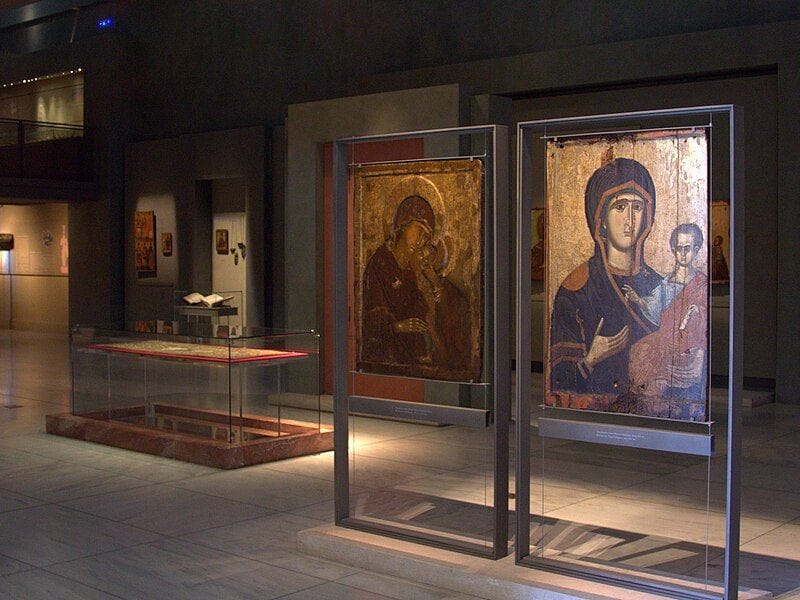
Room 10 covers the final two centuries of the Byzantine Empire through icons, architectural sculpture and luxury objects from the Palaiologos dynasty period.
These are the most emotionally expressive objects in the collection. The faces are more individuated than in earlier rooms, the colour palette warmer and more complex, the compositions less formally rigid. If you have read about the Palaiologos Renaissance before visiting, this room is where you will see what that term means in practice.
The icons here are of attribution quality comparable to pieces in the Benaki Museum in Athens. They are worth spending 15 to 20 minutes with — longer than most visitors allow.
The two private collections: Papastratou and Oikonomopoulos
Adjacent to Room 10, two private collections are included in the standard admission ticket but are easy to miss. The signposting is modest and the rooms sit slightly off the main circulation route.
The Dory Papastratou Collection holds approximately 800 religious prints from the 17th to 19th centuries — woodcuts, engravings and lithographs printed in Venice, Vienna, Leipzig and Constantinople for Orthodox communities.
These objects document how Byzantine visual culture spread through print technology after 1453. No comparable collection is publicly accessible elsewhere in Greece.
The Dimitrios Oikonomopoulos Collection covers liturgical manuscripts and Byzantine musical notation through 18th and 19th-century choir books. Both collections are worth the 10-minute detour.
Recommended routes through the Byzantine Museum in Thessaloniki
For a 60-minute visit: Rooms 1, 3, 5, 6 and 10. This sequence gives one representative room from each major period and includes the two objects most visitors find most memorable — the floor mosaic in Room 3 and the Palaiologos icons in Room 10.
For a 90-minute visit: add Rooms 2, 7 and 8, plus the Papastratou Collection. This covers the full chronological range without attempting every room.